
Understanding the Bachelor of IT in Interactive Design requirements is an important first step for students who want to combine technology, creativity and user-focused problem-solving.
This undergraduate degree is designed for students interested in websites, applications, digital platforms and the way people interact with technology. It combines information technology, design thinking, business intelligence and application development.
Prospective students can explore the Bachelor of Information Technology in Interactive Design at Regenesys. The programme is completed over three years and is available through contact, online and distance learning options.
Students who are ready to begin their application journey can also check their eligibility and enquire about the next intake.
Bachelor of IT in Interactive Design at a Glance
Qualification: Bachelor of Information Technology in Interactive Design
Duration: 3 years
NQF level: Level 7
SAQA ID: 123668
Study modes: Contact, online and distance
Programme focus: Design thinking, business intelligence, application design and development
The qualification develops the technical, creative and analytical capabilities needed to build interactive digital solutions. Students learn how digital products are planned, developed, tested and improved for real users.
What Is a Bachelor of IT in Interactive Design?
A Bachelor of IT in Interactive Design is an undergraduate technology degree that combines computing with user-centred digital design.
Traditional information technology programmes often focus heavily on software, databases, networks and systems. Interactive design adds another important dimension: how people experience and interact with digital products.
Students learn to consider questions such as:
- Can users understand the digital product?
- Is the website or application easy to navigate?
- Does the interface respond clearly to user actions?
- Can users complete important tasks efficiently?
- Is the product accessible on different devices?
- Does the digital experience support business goals?
Interactive design can apply to websites, mobile applications, banking platforms, online shops, learning systems, business software and public-service portals.
Bachelor of IT in Interactive Design Requirements
The Bachelor of IT in Interactive Design requirements help determine whether an applicant has the academic and technical foundation needed for undergraduate study.
Applicants should review both the academic requirements and the practical technology requirements before applying.
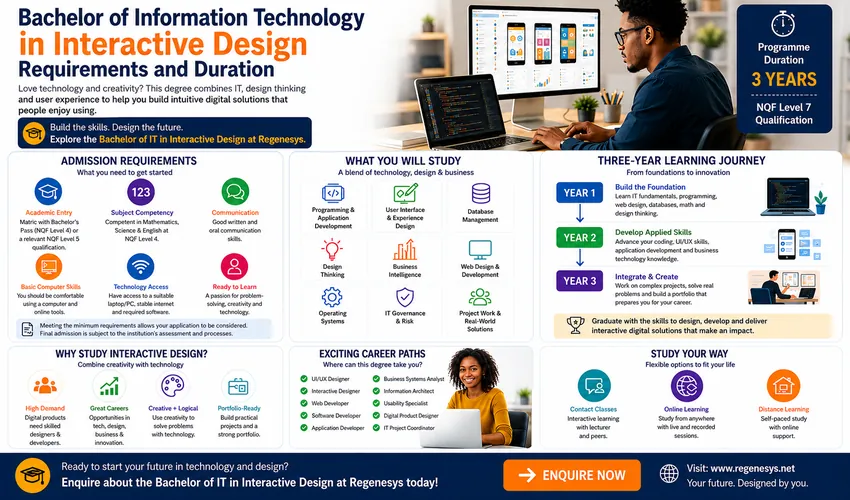
Academic Bachelor of IT in Interactive Design Requirements
Applicants should have one of the recognised academic entry routes.
- Matric with a Bachelor pass or an equivalent NQF Level 4 qualification
- Alternatively, a relevant NQF Level 5 qualification from an accredited institution, subject to the applicable admission requirements
- Competency in Mathematics, Science and English at NQF Level 4
- Competent written and oral communication skills
Meeting the minimum requirements allows an application to be considered. Final admission remains subject to the institution’s assessment and application process.
Technology Requirements for Interactive Design Students
The programme includes programming, web design, databases and application development. Students therefore need access to suitable technology.
Applicants should have:
- Basic computer skills
- A suitable laptop or desktop computer
- A stable internet connection
- Access to the required software and IT resources
- The ability to use digital learning platforms
- A suitable environment for assignments and practical projects
A mobile phone alone may not be sufficient for programming, interface design, software development and database activities.
Do You Meet the Bachelor of IT in Interactive Design Requirements?
The Regenesys admissions team can review your academic background and explain the application routes available to you.
Check your eligibility and request programme information.
Why Is Mathematics Important for Interactive Design?
Mathematics is relevant because the programme includes programming, information systems, data, databases and technical problem-solving.
Students may use mathematical and logical thinking when working with:
- Programming structures
- Algorithms
- Database relationships
- Business intelligence
- Application logic
- Interface measurements
- Data interpretation
- Systems analysis
Interactive design is therefore not a purely artistic qualification. Students must balance creativity with structured, logical and technical thinking.
Applicants who are uncertain about their Mathematics background should contact admissions for guidance before applying.
Do You Need Previous Coding Experience?
Advanced coding experience is not normally listed as a standard admission requirement. However, basic exposure to programming can help students prepare for the degree.
Prospective students can build a foundation by exploring:
- Basic HTML
- Basic CSS
- Introductory Python
- Programming logic
- File and folder management
- Digital research
- Basic interface-design principles
The programme develops knowledge progressively. Students begin with foundational concepts before moving towards more complex application development and interactive systems.
Who Should Study Interactive Design?
A Bachelor of IT in Interactive Design may suit students who enjoy both technology and creativity.
The degree may be appropriate for people who:
- Enjoy solving practical problems
- Are interested in websites and applications
- Want to understand how people use technology
- Enjoy visual design and structured thinking
- Want to learn programming
- Are interested in user experience and interface design
- Prefer practical and project-based learning
- Want a career combining creative and technical skills
Students should also be willing to test their work, receive feedback and improve their solutions. Interactive design is an iterative process that often involves several rounds of research, development and refinement.
Bachelor of IT in Interactive Design Duration
The standard Bachelor of IT in Interactive Design duration at Regenesys is three years.
The three-year structure gives students time to develop foundational information technology knowledge, applied design capabilities and practical project experience.
| Study year | Main learning focus |
|---|---|
| Year 1 | Information technology, programming, databases, web design and design-thinking foundations |
| Year 2 | Applied development, interactive systems, user-centred design and business integration |
| Year 3 | Advanced application, integrated projects, testing and portfolio development |
The actual completion period may be affected by academic progression, module completion, assessment results and the institution’s academic rules.
How Is the Three-Year Degree Structured?
Year 1: Building the Foundation
The first year introduces students to essential information technology and interactive design concepts.
Learning areas may include:
- Information Technology
- Python Programming
- Database Management Systems
- Mathematical Foundations
- Operating Systems
- Web Design with HTML
- Design Thinking
- Information Systems
- IT Governance and Risk Management
The first year helps students develop the technical and conceptual foundation needed for later study.
Year 2: Developing Applied Skills
During the second year, students begin applying their knowledge to more complex technical and design challenges.
They may develop capabilities in:
- Application development
- Advanced programming concepts
- User-centred design
- Interactive systems
- Digital product planning
- Business intelligence
- Software-development processes
- Technology and business integration
Assignments may require students to combine several areas of learning rather than treating each subject separately.
Year 3: Integrating Knowledge
The final year generally focuses on advanced application, integration and practical project work.
Students may be expected to:
- Plan and develop interactive digital products
- Apply design-thinking methods
- Use programming and database knowledge
- Test applications and interfaces
- Present and explain design decisions
- Complete integrated or capstone projects
- Build portfolio-ready work
This stage helps students connect technical knowledge, creative thinking and business understanding in practical projects.
Bachelor of IT in Interactive Design Subjects
The programme combines technology, design and business-focused learning.
Technology Subjects
- Programming
- Web design and development
- Database management
- Operating systems
- Application development
- Software testing
- Information systems
- IT governance
- Technology risk
Interactive Design Subjects
- Design thinking
- User-centred design
- Interface planning
- Wireframing
- Prototyping
- Usability
- Visual communication
- Interaction design
Business-Focused Subjects
- Business intelligence
- Digital marketing
- Project planning
- Technology strategy
- Stakeholder communication
- Customer requirements
This multidisciplinary structure helps students understand both how digital products are built and how users experience them.
What Is the Difference Between Interactive Design, UX and UI?
| Area | Main focus |
|---|---|
| Interactive design | How a digital product responds when a person uses it |
| User experience design | The complete experience a person has while using a product |
| User interface design | The visible and interactive elements, including buttons, menus, forms and layouts |
Interactive design examines actions, feedback, navigation and system behaviour.
User experience design considers whether the complete product is useful, accessible and easy to use.
User interface design focuses on visible elements such as buttons, menus, colours, typography, forms and layouts.
A Bachelor of IT in Interactive Design can introduce students to all three areas while also building programming and information technology knowledge.
Bachelor of IT in Interactive Design Study Options
Regenesys offers contact, online and distance learning formats for the programme.
Online or distance learning may suit students who:
- Live far from the campus
- Need greater flexibility
- Have work or family responsibilities
- Are comfortable using digital learning platforms
- Can maintain an independent study routine
- Have reliable technology and internet access
Flexible learning does not reduce the academic requirements. Online and distance students still need to complete assignments, practical activities, projects and assessments.
Can You Work While Studying?
Some students may be able to work while completing the online or distance version of the programme.
However, they should plan carefully around:
- Classes and learning sessions
- Weekly study time
- Assignment deadlines
- Group projects
- Programming practice
- Design activities
- Examinations
- Capstone projects
Technology and design skills develop through continuous practice. Students should create a realistic study schedule and avoid leaving practical work until the last minute.
Skills Developed During the Bachelor of IT in Interactive Design
Technical Skills
- Programming
- Web development
- Application development
- Database management
- Systems analysis
- Software testing
- Information technology fundamentals
Design Skills
- User research
- Wireframing
- Prototyping
- Interface design
- Usability evaluation
- Design thinking
- Visual communication
Transferable Skills
- Critical thinking
- Creative problem-solving
- Communication
- Teamwork
- Research
- Project coordination
- Presentation
- Time management
Bachelor of IT in Interactive Design Careers
Graduates can explore careers that combine technology, design and digital product development.
User Interface Designer
User Experience Designer
Interactive Designer
Web Designer
Web Developer
Software Developer
Application Developer
Business Systems Analyst
Information Architect
Multimedia Designer
Usability Engineer
IT Project Manager
Creative Technology Specialist
Digital Product Designer
Employment opportunities depend on the graduate’s technical ability, portfolio, practical experience and the employer’s specific requirements.
Why Is a Portfolio Important?
A qualification confirms that a student has completed structured academic learning. A portfolio shows employers what the graduate can create.
A strong portfolio may include:
- Website prototypes
- Mobile application concepts
- Wireframes
- User-interface designs
- Programming projects
- Database projects
- User-research findings
- Usability tests
- Digital product concepts
- Capstone projects
Each project should explain the problem, intended users, design process, tools used, the student’s contribution and the final solution.
How to Apply for a Bachelor of IT in Interactive Design
Before applying, prospective students should confirm that they meet the Bachelor of IT in Interactive Design requirements.
- Review the programme information
- Check the academic and technology requirements
- Complete the application process
- Submit the requested supporting documents
- Pay the applicable application fee
- Complete any additional assessments requested by admissions
- Review the admission outcome
- Finalise registration and fee arrangements
Build a Career Where Technology Meets Creativity
The Regenesys degree develops capabilities in programming, application development, design thinking and business intelligence over three years.
Apply or enquire about the Bachelor of Information Technology in Interactive Design.
Study Interactive Design at Regenesys
The Regenesys Bachelor of Information Technology in Interactive Design is designed for students who want to combine technical, creative and business-focused learning.
The three-year programme includes programming, databases, design thinking, business intelligence and application development.
Students can choose between contact, online and distance study options, subject to programme availability and institutional requirements.
View the programme requirements and enquire about admission.
Why Choose Regenesys?
Students can benefit from:
- A qualification positioned at NQF Level 7
- Flexible contact, online and distance learning options
- Technology, design and business subjects
- Practical and project-based learning
- Integrated and capstone projects
- Admissions and academic support
- Financial-assistance options for qualifying students
Prospective students can also explore other Regenesys undergraduate and technology programmes.
Conclusion
The Bachelor of IT in Interactive Design requirements are intended to confirm that applicants have the academic, communication and technical readiness needed for undergraduate technology studies.
Applicants generally need Matric with a Bachelor pass or an equivalent qualification, competency in the relevant academic areas and access to the technology required for practical learning.
The programme takes three years to complete and combines programming, databases, design thinking, application development, business intelligence and user-focused digital design.
It may be suitable for students who want to create functional digital products while understanding the people who use them.
Frequently Asked Questions
What are the Bachelor of Information Technology in Interactive Design requirements?
Applicants generally need Matric with a Bachelor pass or an equivalent NQF Level 4 qualification. A relevant NQF Level 5 qualification may also provide an admission route. Applicants should also meet the Mathematics, Science, English, communication and technology requirements.
How long does the Interactive Design degree take?
The standard programme duration at Regenesys is three years.
Do I need coding experience before applying?
Advanced coding experience is not normally required. However, introductory knowledge of HTML, CSS, Python or programming logic can help students prepare.
Can I study the degree online?
Yes. Regenesys offers contact, online and distance learning options for the programme.
Is Interactive Design the same as graphic design?
No. Graphic design focuses mainly on visual communication. Interactive design also considers how users navigate, respond to and complete tasks within websites, applications and digital systems.
What careers can graduates pursue?
Graduates can explore roles such as User Interface Designer, User Experience Designer, Interactive Designer, Web Designer, Software Developer, Business Systems Analyst, Information Architect and Usability Engineer.