Can you get a job with an advanced certificate? Yes, an Advanced Certificate in Business Management can strengthen your application for suitable business, administrative, supervisory and junior-management positions.
However, completing the qualification does not automatically guarantee employment. Employers may also consider your workplace experience, practical abilities, industry knowledge, communication skills and suitability for the advertised position.
Therefore, the qualification is often most valuable when it complements skills and experience you have already developed. It may help you formalise your business knowledge, prepare for greater responsibility and demonstrate your commitment to professional development.
This article answers the question, “Can you get a job with an advanced certificate?” It also explores potential career paths, employability skills, further-study opportunities and practical ways to strengthen your job applications.
Prospective students can learn more about the Regenesys Advanced Certificate in Business Management .
This blog outlines whether you can get a job with an Advanced Certificate in Business Management in South Africa, the types of business, administrative, coordinating and junior-management roles graduates may explore, and the skills employers may consider alongside the qualification. It explains what an NQF Level 6 Advanced Certificate means, how work experience can influence employability, whether the qualification may support promotion or further study, and how professionals across South Africa can strengthen their employment prospects after graduating. It also explores the Regenesys Advanced Certificate in Business Management as a pathway for developing practical business, management and decision-making capabilities.
TABLE OF CONTENTS
The Quick Answer
Yes, an advanced certificate can support your employment prospects.
It can show employers that you have completed formal business studies and developed knowledge relevant to workplace operations, administration, coordination and management support.
Nevertheless, employers will normally evaluate the qualification together with your experience, practical skills and overall suitability for the role.
What Is an Advanced Certificate in Business Management?
An Advanced Certificate in Business Management is a vocational qualification that develops practical knowledge of how organisations, teams, processes and resources are managed.
It typically builds on foundational learning completed through a Higher Certificate or another appropriate qualification. Consequently, it is generally suited to learners who want to advance beyond introductory business concepts.
The programme may strengthen knowledge in areas such as:
- Business-management principles
- Operations management
- Financial decision-making
- Economics
- Information management
- Leadership and people management
- Business communication
- Problem-solving
- Planning and coordination
- Workplace decision-making
Rather than focusing only on theory, a vocational advanced certificate is intended to help learners understand how business principles can be applied in practical workplace situations.
What Does an NQF Level 6 Qualification Mean?
Within South Africa’s Higher Education Qualifications Sub-Framework , an Advanced Certificate is positioned at NQF Level 6. This places it above a Higher Certificate, which is commonly positioned at NQF Level 5.
The level indicates the complexity of the learning completed. At NQF Level 6, students are expected to engage with more advanced knowledge and apply what they have learned within relevant professional or vocational contexts.
| Qualification | Typical NQF Level | General Purpose |
|---|---|---|
| Higher Certificate | NQF Level 5 | Introduces foundational knowledge and may support entry-level employment or further study. |
| Advanced Certificate | NQF Level 6 | Builds on previous learning and develops more advanced vocational and professional capabilities. |
However, an NQF level does not determine your job title automatically. Employers will still consider the relevance of the qualification, your work history and the requirements of the position.
It is also important not to assume that qualifications are equivalent simply because they appear at the same NQF level. The South African Qualifications Authority explains that qualifications registered at the same NQF level are not automatically equivalent because individual qualifications can have different purposes and exit-level outcomes.
Can You Get a Job With an Advanced Certificate?
Yes, you can apply for employment with an advanced certificate. The qualification can demonstrate that you have developed formal knowledge beyond an introductory certificate level.
When people ask, “Can you get a job with an advanced certificate?” it is important to remember that the answer depends partly on the role they are targeting.
For example, an applicant with administrative experience and an Advanced Certificate in Business Management may be well positioned to explore coordination, management-support or supervisory opportunities.
On the other hand, someone with limited experience may first need to build practical exposure through an assistant, administrative or junior coordinating position.
Your employment prospects may be stronger when the qualification is supported by:
- Relevant workplace experience
- Strong verbal and written communication
- Administrative or supervisory experience
- Problem-solving ability
- Computer and digital literacy
- Knowledge of the employer’s industry
- A professional CV and LinkedIn profile
- Good interview preparation
What Jobs Can You Get With an Advanced Certificate in Business Management?
The positions available to you will depend on your experience, previous qualifications, industry knowledge and each employer’s requirements.
Possible roles to explore include:
Business Assistant
Supports managers with administration, coordination, reporting and daily business activities.
Management Assistant
Assists with scheduling, workplace communication, meetings, documents and operational support.
Administrative Coordinator
Coordinates office systems, records, suppliers, schedules and internal communication.
Operations Assistant
Supports workflows, service delivery, reporting and the effective use of organisational resources.
Project Coordinator
Assists with project documentation, schedules, communication, meetings and progress tracking.
Customer Service Supervisor
Supports service teams, monitors service quality and helps resolve escalated customer concerns.
Sales Administrator
Supports sales processes, customer records, quotations, orders and team reporting.
Junior Operations Manager
May supervise daily activities, employees and operational targets when supported by suitable experience.
Administration Manager
Oversees administrative systems, staff, office resources, records and internal processes.
Business Manager
May coordinate people, resources and business activities, usually after gaining relevant experience.
Several of these positions may require previous workplace or supervisory experience. Therefore, graduates should read job descriptions carefully and target roles that match both their qualifications and employment backgrounds.
Which Industries Employ Business-Management Graduates?
Business-management knowledge is useful across many industries because organisations need professionals who can coordinate processes, support employees, manage information and contribute to effective service delivery.
- Banking and financial services
- Retail and wholesale
- Hospitality and tourism
- Healthcare administration
- Education and training
- Logistics and transport
- Manufacturing
- Technology and telecommunications
- Government and public entities
- NGOs and community organisations
- Professional services
- Small and medium-sized businesses
Job titles may vary between industries. For instance, similar responsibilities may be advertised under titles such as office coordinator, branch administrator, programme assistant, operations administrator or management assistant.
Does an Advanced Certificate Guarantee Employment?
No qualification can guarantee that a graduate will receive a job offer.
An advanced certificate can improve your knowledge and strengthen your professional profile. Nevertheless, the final hiring decision remains with the employer.
Employers may assess:
- The relevance of your qualification
- Your previous work experience
- Your technical and digital abilities
- Your communication skills
- Your knowledge of the industry
- Your leadership potential
- Your references and employment record
- Your performance during the interview process
Your employability profile:
Qualification + Experience + Practical skills + Professional presentation = a stronger employment application.
Therefore, the qualification should be viewed as one important part of your employment profile rather than the only factor that matters.
How Does Work Experience Affect Your Job Prospects?
Work experience demonstrates that you have applied skills in a real organisational environment.

Relevant experience does not always need to come from a formal management position. You may already have developed valuable business skills through:
- Administrative work
- Customer service
- Sales
- Team support
- Employee scheduling
- Stock management
- Report preparation
- Volunteer projects
- Committee responsibilities
- Running a small business
For example, an administrative assistant who coordinates schedules, prepares reports and supports a department manager may already possess experience relevant to an office-coordinator or management-assistant position.
The advanced certificate can then help the employee understand the broader management principles behind the tasks they already perform.
Which Skills Do Employers Value in Business-Management Graduates?
Employers generally seek people who can contribute to workplace performance, not only applicants who hold formal qualifications.
Business Skills
- Planning and organisation
- Operations awareness
- Financial understanding
- Information management
- Problem-solving
- Decision-making
- Performance monitoring
Workplace Skills
- Communication
- Teamwork
- Professionalism
- Adaptability
- Time management
- Accountability
- Digital literacy
Strong candidates can explain how they have used these abilities to solve problems, support colleagues, serve customers or improve a business process.
Business knowledge becomes particularly valuable when professionals can recognise how different business functions interact in real situations. For example, the RegInsights article Black Friday South Africa Is a Real-World Lesson in Business and Consumer Behaviour explores how areas such as pricing, consumer behaviour, marketing, finance and strategic decision-making come together within a real business environment.
How Can You Improve Your Employability After Graduating?
Completing the qualification should be followed by practical career-development steps.
1. Identify Suitable Roles
Compare your experience with realistic administrative, coordinating, supervisory and management-support positions.
2. Update Your CV
Include the qualification, relevant subjects, practical projects and measurable workplace achievements.
3. Strengthen Digital Skills
Build confidence in spreadsheets, presentations, email, virtual meetings and business-management systems.
4. Build Evidence
Keep examples of plans, reports, process improvements and projects that demonstrate your contribution.
5. Grow Your Network
Connect with professionals, former classmates, recruiters, employers and relevant industry groups.
6. Prepare for Interviews
Practise explaining how your qualification, experience and skills can help the organisation.
You can also improve your employment prospects by volunteering for additional responsibilities in your current workplace.
For instance, you could offer to coordinate a small project, train a new colleague, prepare a report or help improve an administrative process.
How Should You Add an Advanced Certificate to Your CV?
Add the qualification clearly under the education section of your CV.
CV Example
Advanced Certificate in Business Management
Regenesys Business School
NQF Level 6 | Completed: [Year]
Relevant areas: Business management, operations, economics, financial management and information management.
You should also connect your qualification to your workplace achievements. Employers want to understand how your knowledge has helped you create value.
Instead of writing only that you were responsible for administration, explain what you achieved.
Coordinated weekly operational reports for three departments and improved the accuracy of management information by introducing a standard reporting template.
This example is more effective because it explains the responsibility, scope and outcome of the employee’s work.
Can an Advanced Certificate Help You Earn a Promotion?
An advanced certificate may strengthen your readiness for promotion, particularly when the programme develops skills required for the next level of responsibility.
It may help prepare you for responsibilities such as:
- Supervising employees
- Coordinating administrative processes
- Managing small projects
- Monitoring team performance
- Managing workplace resources
- Supporting operational decisions
- Reporting to departmental managers
However, promotion decisions also depend on workplace performance, available positions, organisational policies and your employer’s selection criteria.
Employees should discuss their career-development goals with their managers and seek opportunities to apply what they learn.
Can You Study Further After an Advanced Certificate?
An advanced certificate may provide access to further learning, depending on the admission requirements of the institution and programme you want to enter.
Possible pathways may include another business qualification or an appropriate programme at a higher NQF level.
However, admission is not automatic. The institution may assess:
- The qualification you completed
- Your subjects and credits
- Your academic results
- The relevance of your previous studies
- Any required workplace experience
- The programme’s formal admission criteria
Contact the institution before applying to confirm the progression routes available to you.
Professionals planning a longer-term academic journey may also benefit from understanding how business qualifications become more specialised at higher levels. The RegInsights article Postgraduate Diploma in Business Management vs Business Administration: What Is the Difference? explores how management and administration pathways can differ in their emphasis on leadership, strategy, organisational processes and operational coordination.
This does not mean that an Advanced Certificate automatically provides admission to a postgraduate diploma. Each qualification has its own level, entry requirements and progression criteria.
Is an Advanced Certificate in Business Management Worth It?
The qualification may be worthwhile when it supports your career goals and develops knowledge that is relevant to your workplace or target industry.
It may be suitable when you want to:
- Develop formal management knowledge
- Move from an entry-level role towards supervision
- Strengthen your business decision-making skills
- Prepare for greater workplace responsibility
- Complement your existing practical experience
- Create a possible pathway towards further study
Before enrolling, compare the programme content with the roles you want to pursue. Additionally, review the admission criteria, learning format, study commitment and recognition of the qualification.
Who Should Study an Advanced Certificate in Business Management?
The qualification may suit:
- Higher Certificate graduates
- Administrative employees
- Team leaders
- Supervisors
- Operations employees
- Customer-service professionals
- Sales administrators
- Small-business owners
- Professionals preparing for junior management
- Employees who want a formal business qualification
It can be particularly relevant for professionals who want to connect their workplace experience with structured business-management knowledge.
Study the Advanced Certificate in Business Management at Regenesys
The right business qualification should help you understand management principles and apply them to organisational challenges.
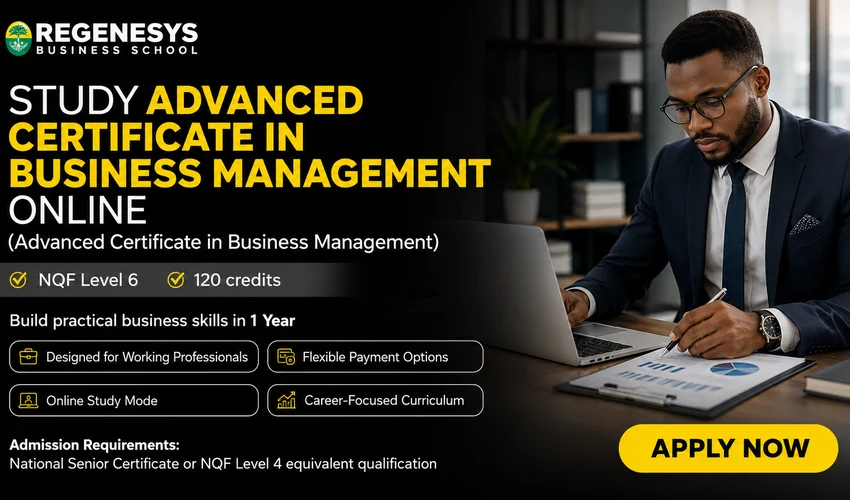
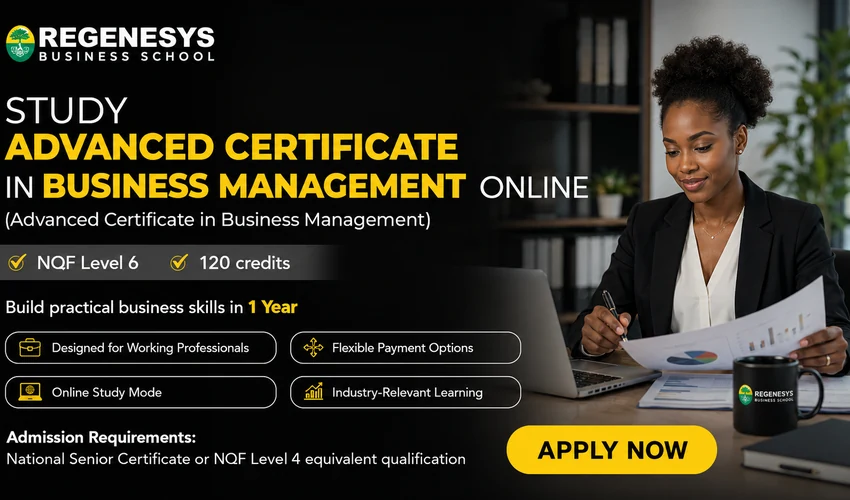
The Regenesys Advanced Certificate in Business Management is designed to develop practical business, management and decision-making capabilities.
Programme Overview
| NQF Level | Level 6 |
|---|---|
| Duration | 1–2 years |
| Credit Points | 125 |
| Study Modes | Contact, Online and Distance |
The programme is intended for learners who want to strengthen their knowledge of core business functions and prepare for junior or middle-management environments.
Possible career paths include business support, administration, management assistance and business-management roles, depending on the graduate’s experience and the requirements of each employer.
Explore the Advanced Certificate in Business Management
Apply to Regenesys and develop practical business-management skills for your next career step.
Final Thoughts
So, can you get a job with an advanced certificate? Yes, the qualification can support applications for suitable business, administrative, coordinating and junior-management roles.
Nevertheless, your strongest employment profile will combine formal education with practical experience, workplace achievements and relevant professional skills.
Apply for roles that match your current level, explain your achievements clearly and continue building experience after graduation.
For professionals seeking greater responsibility, an Advanced Certificate in Business Management can provide a valuable next step towards stronger business knowledge and career development.
Frequently Asked Questions
Can you get a job with an Advanced Certificate in South Africa?
Yes. An Advanced Certificate can support applications for suitable business, administration, coordination, supervisory and junior-management roles in South Africa. Employment is not guaranteed, and employers may also consider your experience, skills, industry knowledge and suitability for the particular position.
What jobs can you get with an Advanced Certificate in Business Management in South Africa?
Depending on your experience and the employer’s requirements, you may explore roles such as Business Assistant, Management Assistant, Administrative Coordinator, Operations Assistant, Project Coordinator, Sales Administrator and other business-support positions. Professionals with relevant experience may also explore supervisory or junior-management opportunities.
What NQF level is an Advanced Certificate in South Africa?
An Advanced Certificate is positioned at NQF Level 6 within South Africa’s higher-education qualifications framework. Students should still check the registered details, credits and admission requirements of the specific qualification they intend to study.
Is an Advanced Certificate equal to a degree in South Africa?
No. An Advanced Certificate and a bachelor’s degree are different qualification types with different purposes, structures and learning outcomes. Qualifications should not be considered equivalent simply because they may share or sit near particular NQF levels.
Can an Advanced Certificate help me find a job in Johannesburg or Gauteng?
It can strengthen your professional profile when applying for suitable business, administration and management-support opportunities in Johannesburg and elsewhere in Gauteng. Your employment prospects will still depend on your experience, skills and the requirements of each vacancy.
Can I use an Advanced Certificate in Business Management when applying for jobs in Cape Town?
Yes. Business-management capabilities such as communication, planning, coordination, problem-solving and operations knowledge are relevant across locations. Applicants in Cape Town and the Western Cape should compare their qualifications and experience with the requirements of each advertised role.
Is an Advanced Certificate useful for business careers in Durban and KwaZulu-Natal?
It can be relevant to business, administrative, operations and management-support roles in Durban and KwaZulu-Natal, depending on the employer and industry. Its value can be stronger when supported by relevant workplace experience and practical skills.
Can I study the Regenesys Advanced Certificate in Business Management online in South Africa?
Yes. The Regenesys Advanced Certificate in Business Management offers contact, online and distance study modes, allowing learners in different parts of South Africa to select an appropriate learning option.
Can an Advanced Certificate help me get promoted in South Africa?
It may strengthen your readiness for additional responsibility by developing business and management knowledge. However, promotions also depend on workplace performance, available positions, organisational policies, experience and the employer’s selection requirements.
Can I study further after an Advanced Certificate in Business Management in South Africa?
Potentially, yes. An Advanced Certificate may contribute to a further-study pathway depending on the qualification you want to pursue and the admission requirements of the institution. Admission is not automatic, so students should confirm the relevant progression and articulation requirements before applying.