Business management plays a role in almost every organisation, from small businesses and start-ups to large corporations, government-linked entities and multinational companies.
Behind the products, services and strategies of these organisations are people responsible for managing teams, allocating resources, solving problems, understanding customers and helping the organisation achieve its goals.
For students and professionals interested in developing these capabilities, business management courses can provide several possible study pathways. The right option depends on your current qualification, career stage, professional goals and the depth of business knowledge you want to develop.
In South Africa, business management study can range from foundational certificates to undergraduate degrees and postgraduate qualifications. Understanding how these options differ can help you choose a programme that supports both your immediate goals and your longer-term career direction.
This article explains business management courses in South Africa, including qualification levels, course requirements, study options, business management skills and potential career paths. It compares certificates, degrees and postgraduate study, explores online and contact learning, and explains how students can choose a qualification according to their education and career goals. The article also highlights business management study pathways available through Regenesys Business School.
TABLE OF CONTENTS
What Is Business Management?
Business management is the process of planning, organising and coordinating the people, resources and activities that help an organisation achieve its objectives.
Managers may be responsible for different areas of a business depending on their role and industry. These can include:
- Operations
- People and teams
- Finance and budgets
- Marketing
- Sales
- Projects
- Customer relationships
- Business development
- Strategy
This makes business management a broad field rather than one specific occupation.
A manager in a retail company may face very different daily challenges from someone working in banking, consulting, technology or manufacturing. However, both may need to understand how different business functions work together.
What Are Business Management Courses?
Business management courses are learning programmes that develop knowledge and capabilities related to how organisations operate and how business decisions are made.
Depending on the programme, learners may study subjects relating to management, finance, marketing, human resources, economics, operations, entrepreneurship, communication and strategy.
However, the term “business management course” can describe very different types of study.
One programme may be a short skills course. Another may be a Higher Certificate. Another may be a three-year bachelor’s degree or postgraduate qualification.
This is why prospective students should look beyond the course name and consider the qualification level, accreditation, curriculum, admission requirements, duration and study mode.
What Types of Business Management Qualifications Are Available in South Africa?
South Africa’s National Qualifications Framework provides different qualification levels that can help learners understand the depth and progression of formal study.
The South African Qualifications Authority provides information about qualifications registered on the National Qualifications Framework.
Business management study can therefore take place at several levels.
| Study Level | Typical Purpose | Suitable For |
|---|---|---|
| Higher Certificate | Build foundational business knowledge | School leavers and early-career learners |
| Advanced Certificate | Develop broader applied business capability | Learners progressing beyond certificate level |
| Bachelor’s Degree | Develop broad undergraduate business and management knowledge | Students seeking a comprehensive business qualification |
| Postgraduate Diploma | Develop advanced management knowledge | Graduates and working professionals |
| Master’s Degree | Develop advanced strategic and leadership capabilities | Experienced professionals and managers |
| Doctoral Degree | Advanced research and contribution to management knowledge | Experienced professionals, researchers and senior leaders |
The best level is not automatically the highest one.
The right level depends on the qualifications you already hold and the type of professional responsibility you are preparing for.
How Do You Choose the Right Business Management Course?
Choosing between business management courses in South Africa becomes easier when you begin with your current position rather than the course title.
Ask yourself three questions:
- What qualification do I currently have?
- What type of business knowledge do I need next?
- What career direction am I working towards?
For example, someone leaving school may need a foundational qualification before progressing to degree-level study.
A graduate already working in a specialist profession may instead need a postgraduate management qualification that helps them understand areas beyond their original expertise.
An experienced manager may be considering advanced study focused more strongly on strategy, leadership and organisational decision-making.
If you are comparing qualification levels, the RegInsights guide to Higher Certificate vs Diploma in Business Management explains how different study pathways can affect progression.
What Is a Higher Certificate in Business Management?
A Higher Certificate can provide an entry point into formal business education.
It is generally suitable for learners who want to build foundational knowledge before progressing further academically or professionally.
At Regenesys Business School, the Higher Certificate in Business Management is an NQF Level 5 qualification with 125 credits and a one-year duration.
The programme provides an introduction to core business-management concepts and can support learners developing foundational knowledge in business environments.
This kind of qualification may be appropriate for:
- School leavers entering business education
- People beginning a business-related career
- Working professionals without a formal business qualification
- Entrepreneurs seeking broader business knowledge
- Learners intending to progress to further study
When Should You Consider a Business Management Degree?
A business management degree provides broader and deeper undergraduate study than a foundational certificate.
Degree-level business education typically introduces students to several interconnected areas of an organisation rather than preparing them for only one narrow role.
Students may explore areas such as:
- Management
- Finance
- Marketing
- Human resources
- Operations
- Entrepreneurship
- Strategy
- Business communication
This breadth is useful because businesses rarely operate through isolated departments.
A marketing decision can affect finance. A staffing decision can affect operations. An operational change can influence customers. Management therefore requires the ability to understand how different parts of a business connect.
The Regenesys Bachelor of Business Administration is an NQF Level 7 degree designed to develop broad business, management and leadership knowledge.
Students comparing business degrees can also read the RegInsights guide to business degrees in South Africa for a wider view of business study and career pathways.
What Business Management Course Requirements Should You Check?
Business management course requirements differ according to the level and type of qualification.
A Higher Certificate will not necessarily have the same admission requirements as a bachelor’s degree, while postgraduate business qualifications normally require previous higher education.
Before applying, check:
- The required school-leaving qualification
- The required NQF level
- Whether a previous degree is required
- Whether relevant work experience is required
- Language requirements
- Technology requirements for online study
- Any programme-specific admission criteria
Prospective students should always confirm current admission requirements directly with the institution before applying because requirements can change.
Which Business Management Skills Can You Develop?
Business management education is not simply about learning definitions and theories.
Its broader purpose is to develop ways of thinking that can help people understand and respond to organisational challenges.
Important business management skills can include:
Leadership
Managers need to guide people towards shared objectives while understanding that different employees require different types of support and direction.
Communication
Business professionals may communicate with employees, managers, customers, suppliers and other stakeholders. Clear communication can influence how effectively plans are understood and implemented.
Problem-Solving
Organisations constantly encounter problems involving people, processes, customers, resources and competition. Managers need to identify causes rather than only reacting to symptoms.
Decision-Making
Business decisions often involve incomplete information and competing priorities. Managers need to evaluate available information and consider the consequences of different choices.
Financial Awareness
Even managers who do not work directly in finance may need to understand budgets, costs and how decisions influence organisational resources.
Strategic Thinking
Strategic thinking involves connecting everyday decisions with longer-term organisational goals.
Digital and Data Literacy
Modern businesses increasingly rely on digital systems and data when making decisions. Managers need enough digital awareness to understand information and ask the right questions.
What Jobs Can Business Management Lead To?
One of the most common questions prospective students ask is: What jobs can I get with business management?
There is no single answer because business management is broad.
Career opportunities depend on your qualification level, previous experience, industry, skills and the requirements of individual employers.
Possible career areas can include:
| Career Area | Examples of Roles |
|---|---|
| Business Administration | Business administrator, administrative coordinator |
| Operations | Operations coordinator, operations manager |
| Business Analysis | Junior business analyst, business analyst |
| Sales | Sales coordinator, account manager, sales manager |
| Business Development | Business development representative, business development manager |
| Human Resources | HR administrator, HR coordinator |
| Projects | Project coordinator, project support roles |
| Consulting | Junior consultant, management consultant |
| Customer Management | Customer relations officer, client-service roles |
| Entrepreneurship | Business owner, entrepreneur |
A qualification does not automatically guarantee entry into any particular position.
Work experience, technical skills, professional networks, digital capability and continued development can all influence career progression.
What Does a Business Management Career Path Look Like?
A business management career rarely follows one fixed route.
Someone may begin in administration and later move into operations. Another person may begin in sales and develop into account management or business development. Someone with specialist experience may eventually move into management responsibility.
A simplified progression might look like:
Entry-level role → Coordinator or specialist role → Supervisor → Manager → Senior manager → Executive leadership
However, career progression is not determined by qualifications alone.
As responsibility increases, professionals may need to combine formal learning with workplace experience and stronger capabilities in leadership, decision-making, strategy and people management.

Can You Study Business Management Online in South Africa?
Yes. Many institutions now provide business management courses online, although availability depends on the specific qualification and provider.
Online study can be particularly useful for people who are:
- Working while studying
- Living far from a campus
- Managing family responsibilities
- Looking for greater geographic flexibility
However, online learning should not be viewed as an easier form of education.
Students still need to complete academic work, assessments and other programme requirements.
Online study can also require significant self-management because learners may need to balance study with professional and personal responsibilities.
Online vs Contact Business Management Study: Which Is Better?
Neither study mode is automatically better.
The right option depends on how you learn and what fits your circumstances.
| Online Study | Contact Study |
|---|---|
| Can reduce the need for regular travel | Provides a physical campus environment |
| May suit working professionals | May suit learners who prefer face-to-face interaction |
| Requires strong self-management | Provides more structured physical attendance |
| Allows study from different locations | Provides in-person peer interaction |
When comparing options, focus on the quality and recognition of the qualification rather than assuming that the mode of delivery determines its value.
How Do You Check Whether a Business Management Qualification Is Accredited?
Accreditation and registration should be part of the decision-making process when comparing formal business management qualifications.
The Council on Higher Education explains that programme accreditation evaluates higher education programmes according to established quality criteria.
Before enrolling in a formal qualification, students should verify:
- The institution offering the programme
- The qualification name
- The NQF level
- The relevant registration information
- The accreditation status where applicable
This is particularly important when comparing programmes with similar names because a short course, certificate and formal academic qualification may have very different purposes.
Short Course vs Formal Business Management Qualification
Short courses and formal qualifications can both be useful, but they solve different learning needs.
| Short Course | Formal Qualification |
|---|---|
| Often focuses on a specific capability | Covers a broader academic curriculum |
| Usually shorter | Typically requires longer study |
| Useful for targeted professional development | Supports formal academic progression |
| May not lead to an NQF qualification | Formal qualifications can be registered at an NQF level |
If you need one specific capability, a focused short course may be appropriate.
If you need broader management education or want to progress academically, a formal qualification may be the stronger option.
How Can Business Management Study Support Entrepreneurs?
Business management is also relevant to people who want to build their own organisations.
Having a good business idea is only one part of entrepreneurship.
Business owners may also need to understand:
- Customers
- Finance
- Pricing
- Marketing
- Operations
- Employees
- Planning
- Business growth
Business-management education can help entrepreneurs develop a broader understanding of these areas and how they interact.
It cannot guarantee that a business will succeed, but stronger business knowledge can support more informed decision-making.
How Do Business Management Qualifications Progress at Regenesys?
Regenesys Business School provides business-management study pathways across different qualification levels.
| Qualification | NQF Level | Typical Duration |
|---|---|---|
| Higher Certificate in Business Management | 5 | 1 year |
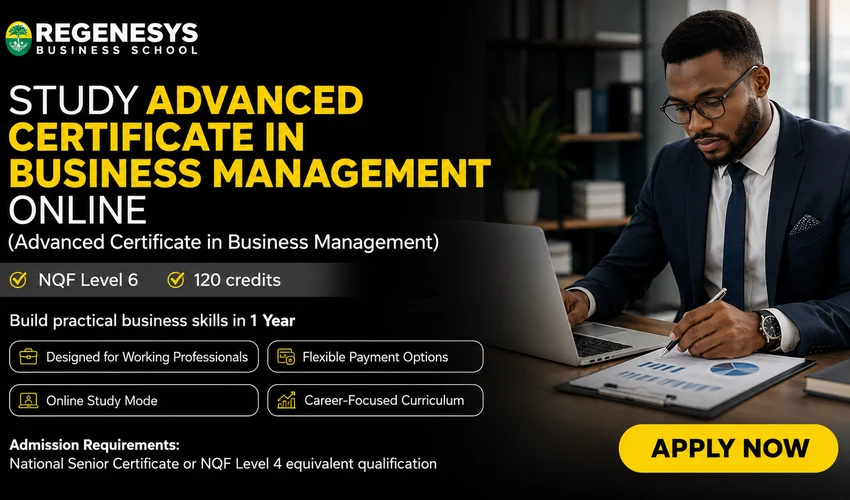
| Advanced Certificate in Business Management | 6 | 1 year |
| Bachelor of Business Administration | 7 | 3 years |
| Postgraduate Diploma in Business Management | 8 | 1 year |
| Master of Business Administration | 9 | 2 years |
| Doctor of Business Management | 10 | 3 years |
This creates different entry and progression points depending on a learner’s existing education and professional experience.
A person beginning their higher education journey may require a different programme from an experienced professional preparing for strategic leadership.
How Should You Choose Between Business Management Courses in South Africa?
When comparing business management courses in South Africa, avoid choosing a programme simply because the title sounds impressive.
Instead, compare:
- Qualification level
- Admission requirements
- Accreditation and registration
- Curriculum
- Study mode
- Duration
- Career relevance
- Opportunities for further study
- Academic and student support
Most importantly, identify the gap between where you are and where you want to go.
A good study decision should help close that gap.
Build Your Business Management Pathway
Business management is not one qualification, one job or one career path.
It is a broad area of study that can support people at different stages of their academic and professional development.
For some learners, the journey may begin with foundational business education. Others may be ready for degree-level study, postgraduate management education or advanced leadership development.
The right choice depends on your starting point.
Before enrolling, consider the qualification level, learning format, career relevance and the type of responsibility you want to take on in the future.
The goal should not simply be to complete a business management course.
It should be to develop knowledge and capabilities that help you make better decisions, understand organisations more clearly and prepare for your next professional step.
Frequently Asked Questions About Business Management Courses in South Africa
What are business management courses in South Africa?
Business management courses in South Africa are learning programmes that develop knowledge relating to the operation and management of organisations. They can range from short courses and certificates to bachelor’s degrees and postgraduate qualifications.
What can I study in business management in South Africa?
Study options may include Higher Certificates, Advanced Certificates, bachelor’s degrees, Postgraduate Diplomas, master’s degrees and doctoral programmes, depending on your previous education and career goals.
What jobs can I get with business management in South Africa?
Possible career areas can include business administration, operations, sales, business development, human resources, consulting, project coordination, customer management and entrepreneurship. Opportunities depend on your qualification, skills, experience and individual employer requirements.
What are the requirements for a business management course in South Africa?
Requirements depend on the qualification level. Certificate and undergraduate programmes may require an appropriate school-leaving qualification, while postgraduate programmes generally require relevant previous higher education. Always confirm current requirements with the institution.
Can I study business management online in South Africa?
Yes. Some South African institutions offer business management qualifications through online study. Students should compare programme recognition, academic requirements, support and delivery format before enrolling.
Is business management a degree?
Business management can be studied through several types of programmes. Some are degrees, while others may be certificates, diplomas, short courses or postgraduate qualifications.
Is a Higher Certificate in Business Management worth considering?
A Higher Certificate can be suitable for learners who want foundational business knowledge or an entry point into further business study. Its suitability depends on your previous qualifications and career plans.
What skills do you learn in business management?
Business management education can develop capabilities such as communication, problem-solving, leadership, decision-making, strategic thinking, financial awareness and understanding of business operations.
What is the difference between business management and business administration?
The terms often overlap. Business management can place greater emphasis on managing people, decisions and organisational direction, while business administration can place greater emphasis on coordinating business functions and processes. The actual distinction depends on the programme and institution.
Where can I study business management in South Africa?
Business management programmes are offered by universities, private higher education institutions, colleges and other education providers in South Africa. Compare accreditation, qualification level, curriculum, study mode, admission requirements and career relevance before choosing a provider.