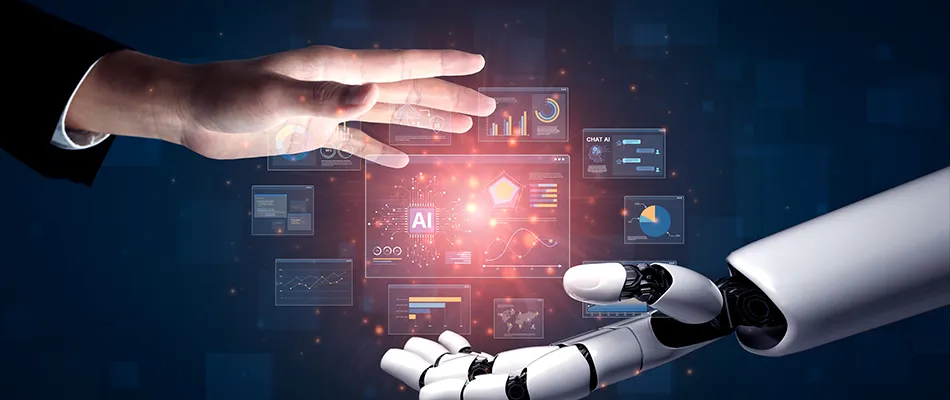

Artificial Intelligence (AI) has been making the headlines for some time now, and, certainly, it is here to stay.
Due to its rapid advancement, AI has already found its way into the daily lives of people across the globe. With further advances in AI and the expansion of its business applications, more organisations will embrace it.
While the potential of AI looks promising, it also has drawbacks. It is necessary to be familiar with the advantages and disadvantages of artificial intelligence. This article will serve as a guide, informing you about these and other related details.
Table of Contents
What Is Artificial Intelligence (AI)?
Before proceeding with the advantages and disadvantages of artificial intelligence, it is important to understand what AI is.
AI is a technology that enables machines and computers to simulate human learning, problem-solving, comprehension, creativity, autonomy, and decision-making. The devices and applications that are powered by AI can take actions independently, without human intervention.
Besides, they are capable of doing the following:
- Identifying and viewing objects
- Comprehending and providing responses to human language
- Learning from new experiences and information.
- Making detailed recommendations to experts and users.
You get exposed to AI daily through personalised shopping recommendations, email spam filters, virtual assistants like Gemini Live and in navigation apps like Google Maps.
Know the Top 10 Key Roles of Artificial Intelligence in Business Education.

Why Is Artificial Intelligence Important?
AI is important because it helps solve some of the toughest global challenges. This includes accelerating medical research, tackling climate change and developing more efficient supply chains. It has the potential to transform healthcare by improving efficiency, reducing costs, and enhancing patient outcomes.
It adds intelligence to existing products, thereby improving them with AI capabilities. An example of this was seen when Apple launched a new generation of products with Siri.
AI’s ability to learn from patterns, make intelligent decisions and analyse data can drive innovation and revolutionise processes.
AI can help save costs in several areas of a company’s operations by automating tasks and enhancing efficiency.
Read: All You Need To Know About An MBA in Artificial Intelligence
How Artificial Intelligence Works?
All AI techniques fundamentally rely on algorithms, data, and computational power. Artificial intelligence systems learn and improve through exposure to large amounts of data, identifying relationships and patterns that humans can miss.
This data acts as the training material. The quantity and quality of the same are vital for the performance of AI.
AI encompasses many key areas, such as:
- Computer Vision: This area enables computers to see and interpret visual information, such as videos and images.
- Natural Language Processing (NLP): With the help of NLP, computers can interpret, generate and understand human language.
- Machine Learning (ML): In this type of AI, the systems learn from data to spot patterns and predict or decide without any direct programming.
- Deep Learning (DL): This is a subfield of ML. It learns from data by using artificial neural networks with multiple layers.
Also read: Benefits of Artificial Intelligence in Business | Know More!
Advantages of Artificial Intelligence
There are multiple benefits of AI. It gives businesses an edge. Organisations use AI to streamline the customer-facing processes, applications and internal processes. The implementation of AI can allow businesses to achieve their results with greater precision and speed.
Let’s take a look at some of the advantages of AI:
Enhances efficiency and productivity
AI can help in streamlining repetitive but essential manual tasks. These include sending emails, drafting sales quotes and developing appointment reminders. This will help free up teams, allowing them to focus on higher-value work.
Sales professionals can ask assistive AI agents to present the top sales leads and give supporting information. Autonomous AI agents can do more than this. They can draft customised emails for every prospect with the help of data from previous interactions.
24/7 availability
While humans can work for about 8 hours a day, AI applications are available 24/7. It is possible for AI-powered chatbots to provide customer service during off-hours. Organisations can benefit from this as they will be able to produce more. In addition, they can deliver an improved customer experience than humans can provide alone.
Eliminates human risk and error
A major benefit of implementing AI is that it reduces human error and risk to humans. Using AI, specifically AI agents, to carry out repetitive tasks can help prevent human error. Also, using AI to complete dangerous and challenging tasks can prevent the risk of harm or injury to humans.
Disadvantages of Artificial Intelligence
Given the benefits mentioned above, it is natural for individuals to consider adopting AI for business purposes immediately. But there are some disadvantages as well. It is equally important to consider the disadvantages of AI alongside its benefits.
Let’s take a closer look at the disadvantages:
Cost of maintenance and implementation
The most significant drawback of implementing AI is the substantial cost of its development. The cost can change based on what AI is required for.
LLMs form the foundation of modern AI applications. Training the LLMs is an expensive and challenging task. It can take several months to complete. In addition, a significant amount of software, hardware and engineering resources are required.
Lack of transparency
Individuals getting exposed to AI while shopping online, applying for jobs or undergoing medical tests deserve to know the process by which AI is using their data.
But not all organisations are upfront about this. This leads to a lack of transparency in the process, further resulting in consumer trust issues. It can even lead to crossing legal boundaries.
Ethical issues
The rapid development and implementation of AI led to a number of ethical questions related to its usage and continuous growth. A common ethical issue is related to the concerns surrounding consumer data privacy.
As AI can recognise patterns, it can collect data on people without having direct access to personal details.

Artificial Intelligence Pros and Cons Across Different Industries
The advantages and disadvantages of artificial intelligence were broadly discussed above. The pros and cons of AI are felt across specific industries such as business, healthcare, and education. It is important to understand these, especially for professionals working in these sectors.
Let’s take a closer look:
Pros of AI in Business
The pros of AI in the business industry are:
- It can provide insights by analysing large amounts of information, resulting in improved business decisions.
- AI-powered customer service tools and chatbots can offer immediate assistance, enhancing customer satisfaction.
- Automating processes can significantly reduce costs in the long run.
Cons of AI in Business
The cons of AI in business are:
- Sensitive business data can be compromised if cyberattacks target AI systems.
- Being highly dependent on AI can reduce human oversight and lead to problems if a technology failure occurs.
- Small business may not be able to deal with the initial investment in AI technology.
Pros of AI in Healthcare
The pros of AI in healthcare include:
- AI can assist in early and accurate diagnosis of diseases by analysing medical data
- AI can help with designing personalised treatment plans on the basis of individual patient data.
- AI helps streamline administrative tasks, thereby lowering the burden on healthcare providers.
Cons of AI in Healthcare
The cons of AI in healthcare are:
- AI handles sensitive medical data, raising privacy concerns.
- AI algorithms can reflect biases that are present in the data, resulting in unequal treatment.
- Healthcare facilities can find it costly to develop and maintain AI systems.
Pros of AI in Education
The pros of AI in education are:
- AI can customise educational content as per the individual needs of every student.
- Students can use AI-powered platforms to gain access to a range of educational resources.
- AI can ensure that educators can focus more on teaching by automating administrative tasks,
Cons of AI in Education
The cons of AI in education are:
- Every student may not have equal access to AI technologies. This can widen the education gap.
- Safeguarding student data from potential breaches is a serious concern.
- Over-relying on AI can reduce the requirement for human teachers. This can impact the student-teacher relationship.
Balancing the Benefits and Risks of Artificial Intelligence
Over-reliance on AI can pose risks. Mitigating them involves striking a balance between using AI for its efficiency and capabilities and ensuring that there is human oversight as well. There are several strategies that companies can adopt to address the over-reliance on AI.
Have a look at them here:
- Regular skill development and training: Conduct training programmes to improve employee decision-making abilities. This helps prepare the workforce to oversee AI systems effectively.
- Robust monitoring and evaluation protocols: Monitor AI performance and decisions by establishing rigorous protocols like regular assessments and audits to evaluate the safety and effectiveness of AI applications.
- Implement human-in-the-loop (HITL) systems: Ensure that human oversight is there in critical decision-making processes.
Responsible and Ethical Use of AI
Given how AI functions, its benefits and drawbacks, it is essential to ensure responsible use of this technology. Also, it is necessary to understand the ethical risks associated with using a specific AI tool and what can be done to mitigate them. Multiple steps can be taken in this regard.
For responsible usage, it is necessary to:
- Be transparent about the usage of AI.
- Use AI in a manner that mitigates bias and promotes inclusivity, accessibility and fairness.
- Consider AI as a collaborator and achieve outcomes by combining it with human intelligence.
- Use AI honestly with human responsibility considered for the outcomes.
- Make efforts to reduce negative impacts and maximise secure, safe use.
Some of the key things to consider to understand the ethical issues related to AI are:
- The data privacy policy for a particular AI tool.
- The data on which an AI system is trained, and the intellectual property issues, inaccuracies, and biases that may be linked to the data source.
- The data that you want to share, control and maintain privacy for.
You can consider enrolling at the reputable Regenesys School of AI to gain an in-depth knowledge of this field. This can help you further understand the responsible usage of AI.
Future Outlook
The future holds immense potential for AI with new advancements pushing the boundaries of what can be achieved by machines. Along with the promising opportunities for the future, it is necessary to ensure governance and careful planning to manage the risks associated with AI.
Organisations and governments should collaborate to establish ethical regulations and guidelines that ensure the responsible usage of AI. Policymakers should invest in training and education programmes that equip individuals with the skills necessary for an AI-driven economy.
By implementing the right strategies, AI can emerge as a force for positive change, solving some of the most pressing global challenges and driving innovation.

Explore Our Other Programmes
Conclusion
AI has become commonplace in everyday life and business as it has boomed recently. It presents immense benefits. But there are risks associated with it as well. It is necessary to carefully consider the benefits and risks of AI to mitigate the negative effects.
AI will likely continue to develop, and we must use it ethically and responsibly.
Now that you are aware of the advantages and disadvantages of artificial intelligence, you should be able to take steps to use it effectively.
Consider Regenesys as your learning partner for gaining knowledge about AI, and make use of it to your advantage in this digital era.
FAQs
What are the advantages and disadvantages of artificial intelligence?
The advantages of AI are that it can eliminate human risk and error and improve efficiency and productivity. The disadvantages of AI include ethical issues and a lack of transparency associated with its use.
Is AI good or bad for the future?
AI can be highly beneficial in the future, but it also has drawbacks. Whether it proves to be good or bad for the future depends on fair regulation, balancing technological advancement with human control and ethical usage.
Will AI take jobs?
AI will not replace human contributions or jobs. It can be used optimally when combined with human insight.
What is the advantage of AI in education?
An advantage of AI in education is that it can personalise educational content to a student’s individual needs.
What is the advantage of AI in healthcare?
AI can analyse medical data to provide assistance in the early and accurate diagnosis of diseases.