
The future of artificial intelligence will not be determined by technology alone. It will also be shaped by who has access to it, who makes decisions about it and who benefits from the opportunities it creates.
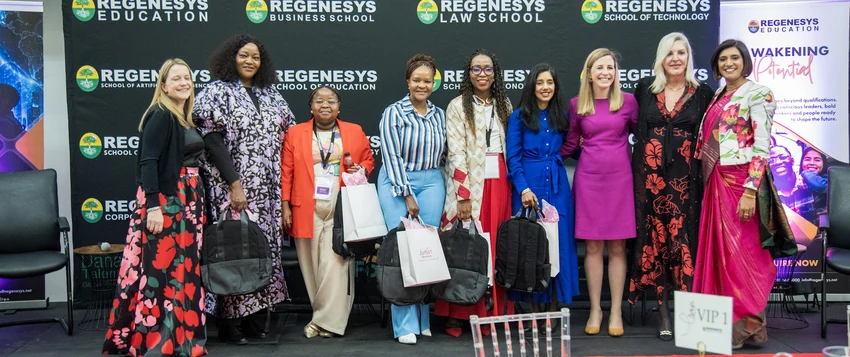
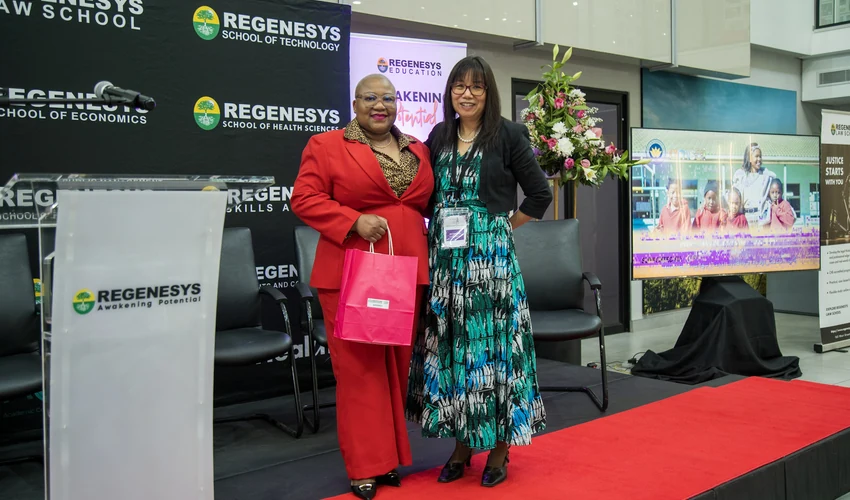
That message was at the centre of the 8th Annual Regenesys Women in Business and Leadership Conference, held at the Regenesys Campus in Sandton on 5 August 2026 under the theme “Women in AI & Business: Empowering Change, Innovation and Inclusive Leadership.”
Bringing together leaders from government, business, technology and civil society, the conference explored the evolving role of women in leadership at a time when artificial intelligence is transforming industries, workplaces and economic opportunity.
The conversations went beyond representation.
Speakers challenged organisations and leaders to consider whether women have meaningful access to finance, technology, markets, networks and decision-making power — and whether the systems being created today will enable women to participate in the AI economy or help shape and own it.
The conference also took place during the 70th anniversary year of the historic Women’s March of 1956, creating a powerful connection between the struggle for equality that came before and the opportunities that must still be created for the generations ahead.
TABLE OF CONTENTS
From Remembering Women’s History to Continuing the Work
Opening the conversation, Indherani Reddy, Head of Regenesys Group for Africa, reflected on the thousands of women who marched to the Union Buildings on 9 August 1956.
Their courage helped create the foundation for many of the freedoms South African women have today. Yet, Reddy reminded delegates that progress should not be mistaken for completion.
“While we have made meaningful progress, their journey remains unfinished. Gender-based violence continues to threaten women’s lives, and too few women occupy positions of leadership.”
Her message established one of the central themes of the conference: honouring the women of the past requires more than remembering them.
It requires continuing their work.
That means addressing the inequalities that still restrict women’s ability to lead, build businesses, participate in the economy and influence the technologies shaping society.
Key Insights from the Regenesys Women in Business and Leadership Conference
Several important themes emerged throughout the conference. Together, they provide a clearer picture of what meaningful progress for women in leadership can look like in an AI-driven economy.
Key Insight 1: Representation Is Important, but Ownership Creates Power
Getting more women into leadership positions remains important, but the conference repeatedly challenged delegates to think beyond representation.
Sthembiso Dlamini, Group Chief Executive Officer of the Gauteng Growth and Development Agency, argued that leadership should ultimately create opportunities for other women.
“Influence may open the door, but impact is measured by how many others you bring through it.”
This distinction matters.
Women can participate in organisations, industries and markets without necessarily having meaningful ownership or decision-making power.
True economic inclusion requires women to have opportunities to:
- Lead organisations
- Build and own businesses
- Access finance
- Enter previously closed networks
- Participate in procurement opportunities
- Influence investment decisions
- Shape emerging industries
Dlamini called for progress that moves women “from participation to ownership.”
For leaders and organisations, the question therefore becomes more than how many women are present.
It becomes: How much influence, ownership and opportunity do women actually have?
Key Insight 2: Women Must Be Architects of the AI Economy
Artificial intelligence is rapidly changing how organisations operate, how decisions are made and which skills will be valued in the future.
But the benefits of that transformation will not automatically be distributed equally.
Shiphra Chisha, Chief Executive Officer of the Graça Machel Trust, highlighted the persistent underrepresentation of women in technology and innovation.
The challenge, she argued, is not a lack of resilience or potential. It is often a lack of access.
Women need access to technology, markets, mentorship, professional networks, skills development and the spaces where important decisions are made.
Her message captured one of the most significant insights from the event:
“In the age of AI, women must be architects of innovation, not merely its beneficiaries.”
The distinction is critical for women in artificial intelligence.
Using AI tools is not the same as influencing how those tools are designed, governed, funded and deployed.
If women are only consumers of artificial intelligence while remaining underrepresented among its developers, executives, investors and policymakers, existing power imbalances may simply be transferred into a new technological era.
Key Insight 3: AI Can Scale Existing Gender Bias
Artificial intelligence is often discussed as though it operates independently of society.
But AI systems learn from data created by people, institutions and historical systems.
That means they can also learn from historical inequalities.
Denise Mukozho, Digital and Product Delivery Leader at Bizmod and Chairperson of the IITPSA Women in IT Chapter, expressed this challenge clearly:
“Artificial intelligence does not invent exclusion; it remembers it.”
If historical data reflects unequal hiring practices, economic exclusion or social stereotypes, AI systems trained on that information may reproduce those patterns.
Because AI can operate at scale, bias can potentially be reproduced faster and across more decisions.
This is why addressing AI gender bias requires more than technical expertise.
Mukozho argued that governance, ethics, accountability and diverse perspectives must remain central to AI implementation.
“Technical excellence alone is not enough. We must pair it with wisdom, accountability and inclusion.”
For businesses adopting artificial intelligence, responsible leadership therefore means asking not only whether an AI system works, but also:
- Who designed it?
- What data was used to train it?
- Whose experiences may be missing from that data?
- Who reviews its decisions?
- Could its outputs disadvantage certain groups?
- Who is accountable when AI gets something wrong?
Diverse leadership can bring the different experiences and perspectives needed to identify these risks.
Key Insight 4: Economic Empowerment Requires Practical Intervention
Gender equality cannot rely entirely on inspirational messages.
It also requires practical measures that address the structural barriers limiting women’s economic participation.
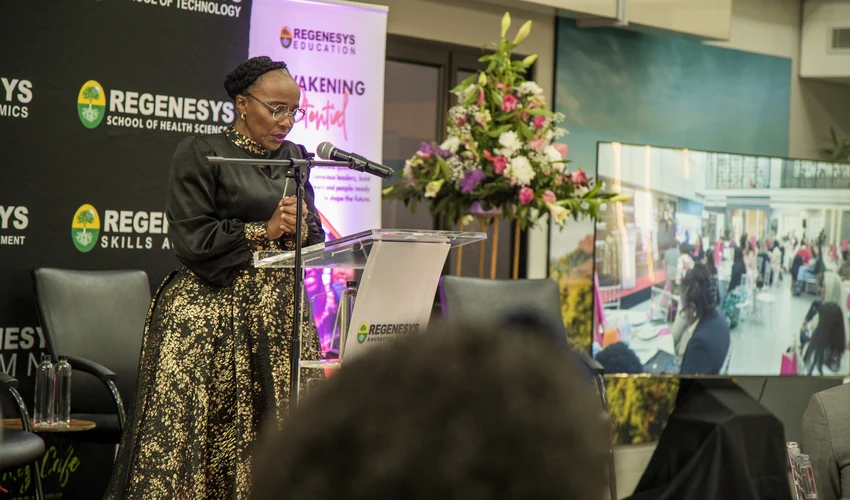
Hon. Sindisiwe Chikunga, Minister in the Presidency for Women, Youth and Persons with Disabilities, called for greater access to financial resources for women.
Among the measures highlighted were expanded microcredit and procurement opportunities for women-owned businesses.
“Access to financial resources must be expanded by scaling up microcredit and introducing mandatory procurement quotas for women-owned businesses.”
The Minister also highlighted another economic issue that is sometimes separated from conversations about leadership: the care economy.
Affordable childcare can directly influence a woman’s ability to study, work, build a business or progress into leadership.
She therefore called for greater investment in quality, affordable childcare while also emphasising that men and boys must share responsibility for household and caregiving work.
This broadened the discussion about women in business beyond individual ambition.
Women’s economic participation is influenced by the systems around them — including access to finance, procurement, childcare, networks and social support.
Creating more women leaders therefore requires addressing these conditions as well.
Key Insight 5: Technology Is Not Neutral
The rise of artificial intelligence and other Fourth Industrial Revolution technologies creates tremendous possibilities.
But technology reflects the priorities and perspectives of the people who create it.
Landela Mahlati, Deputy Director-General at the Gauteng Department of Roads and Transport, argued that women — particularly younger women and those historically excluded from economic opportunities — need opportunities to participate in shaping the technological future.
“If women are excluded from shaping the future, inequality will only deepen.”
This message carries particular importance for women in technology.
Encouraging more girls and women to develop digital skills is one part of the solution.
But inclusion must continue beyond the classroom.
Women must also have opportunities to become:
- Technology professionals
- Entrepreneurs
- Researchers
- Executives
- Investors
- Policymakers
- Innovators
- AI governance leaders
When diverse voices participate in technological development, organisations are better positioned to consider a wider range of experiences, needs and potential consequences.
Key Insight 6: Leadership Should Create More Leaders
One of the strongest threads running through the conference was that leadership is not only about individual advancement.
It is also about what leaders enable for others.
Mentorship matters. Sponsorship matters. Networks matter. And deliberately creating opportunities matters.
Dlamini encouraged successful leaders to consider whether their influence is opening pathways for more women.
Mahlati similarly emphasised that the greatest leaders are not simply remembered for the authority they held, but for the opportunities they gave others.
This changes the definition of successful leadership.
A leader’s legacy can also be measured through:
- The people they mentor
- The women they sponsor
- The businesses they support
- The opportunities they create
- The networks they open
- The next generation they prepare
For women in leadership, individual achievement can therefore become a platform for collective progress.
A Panel Focused on AI, Leadership and Gender Equality
The wider programme brought together women with leadership experience across banking, media, mining, technology, investment, corporate governance and business.
The conference panellists included:
- Storme McDonald, RMB COO
- Prisca Soko, African Women in Business Chairperson
- Dr Anelisa Hlongwane, MultiChoice Group Senior Manager: Human Capital
- Dr Kina Nhlengethwa, SABC Acting GM Radio: PCS, Fortune Combo and Channel Africa
- Mbali Motanyane, Exxaro Resources GM: Corporate Strategy Development and Integration
- Lynelle Bagwandeen, Naspers Group Processes Limited Group Company Secretary and Head of Global Company Secretariat
- Melissa Tighy, eNuus Programme Editor and Anchor
- Annatjie Van Rooyen, CEO of Regenesys Investment Fund
- Indherani Reddy, Head of Regenesys Group for Africa, Regenesys Education
The panel explored the broader question facing businesses and society: Will AI help advance gender equality in leadership, or reinforce existing inequalities?
That question has no automatic answer.
The outcome will depend significantly on the choices organisations make now.
From Conversation to Opportunity
The conference also demonstrated that discussions about inclusion need to be accompanied by action.
Alongside keynote addresses, panel discussions and breakaway sessions, Regenesys introduced the Orange Farm CSI Project and created opportunities for delegates to continue developing their AI knowledge.
Twenty-five guests received complimentary access to Regenesys AI Fundamentals and Prompt Engineering courses through a raffle competition.
This reflects another important lesson from the event: preparing women for an AI-driven economy requires access to learning opportunities.
Digital capability can increasingly influence who participates in emerging industries and who is able to take advantage of new economic opportunities.
For institutions, businesses and policymakers, investment in women’s digital skills can therefore become part of a broader economic inclusion strategy.
What Can Businesses and Leaders Do Next?
The insights from the conference suggest that supporting women in leadership requires action across several areas.
Expand access to leadership.
Women should have meaningful opportunities to move into senior decision-making roles.
Support women-owned businesses.
Procurement and supplier-development strategies can create opportunities for women entrepreneurs to build sustainable enterprises.
Improve access to finance.
Entrepreneurs need capital to start, grow and scale businesses.
Develop AI and digital skills.
Women and girls need opportunities to develop skills that allow them to participate meaningfully in the changing economy.
Build responsible AI governance.
Diverse perspectives should be included when organisations design policies for developing and deploying AI.
Strengthen mentorship and sponsorship.
Experienced leaders can actively create opportunities for women coming behind them.
Open professional networks.
Access to influential networks can affect funding, employment, partnerships and leadership opportunities.
Support the care economy.
Affordable childcare and more equitable caregiving responsibilities can remove barriers to women’s economic participation.
These are not isolated interventions.
Together, they contribute to an environment in which women can move from simply participating in the economy to helping shape it.
What the Next Generation Inherits
Perhaps the most important question is what opportunities today’s decisions will create for the women and girls who come next.
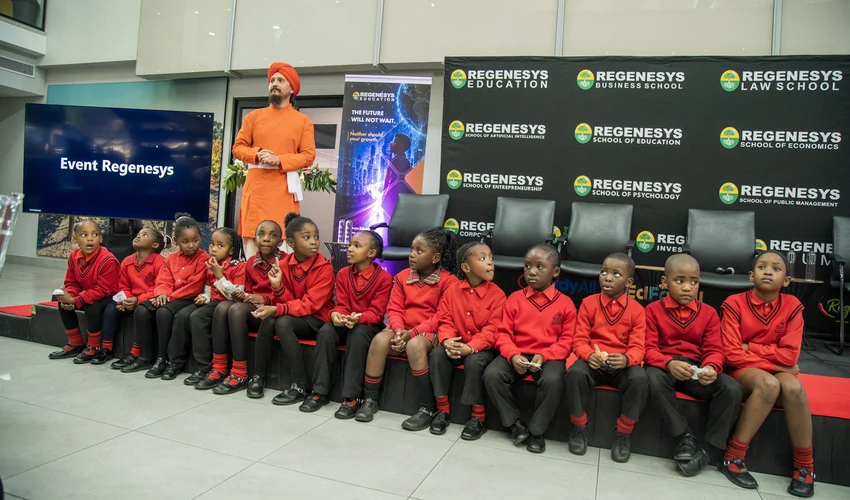
The presence of young learners at the conference offered a visible reminder that conversations about gender equality in leadership extend far beyond the current generation.
The technologies being built today, the policies being introduced and the leadership decisions being made will shape the environment young people eventually enter.
If girls grow up seeing women lead businesses, shape technology, influence policy, build companies and govern artificial intelligence, the possibilities they imagine for themselves can expand.
That makes inclusion an intergenerational responsibility.
From the Women of 1956 to the Women Shaping AI
Seventy years after more than 20,000 women marched to the Union Buildings, South Africa has made important progress.
But the central message from the Regenesys Women in Business and Leadership Conference was that the journey remains unfinished.
The challenge facing today’s leaders is different in form, but familiar in purpose.
It is about ensuring that women have dignity, opportunity, economic power and a meaningful voice in shaping society.
Artificial intelligence now adds another dimension to that work.
The question is no longer only whether women will have access to AI.
It is whether women will help build it, govern it, finance it, lead the organisations using it and own the businesses benefiting from it.
For women in leadership, that is where participation begins to become influence — and influence becomes lasting impact.
As Minister Chikunga reminded delegates:
“Empower women, and we transform communities. Empower women, and we transform nations. Empower women, and we transform the world.”
The future will not become inclusive by accident.
It will become inclusive because leaders choose to build it that way.