
Most people ask whether an MBA is worth it, but that question is too broad to be useful. The better question is this: worth it for what? Some professionals want an immediate career boost. They want to move into management, earn more confidence in meetings, understand finance, lead teams better or position themselves for promotion. Others are thinking further ahead. They want to become executives, entrepreneurs, consultants, board members or strategic leaders who can shape organisations over many years. Both goals are valid. But they are not the same.
Table of Contents
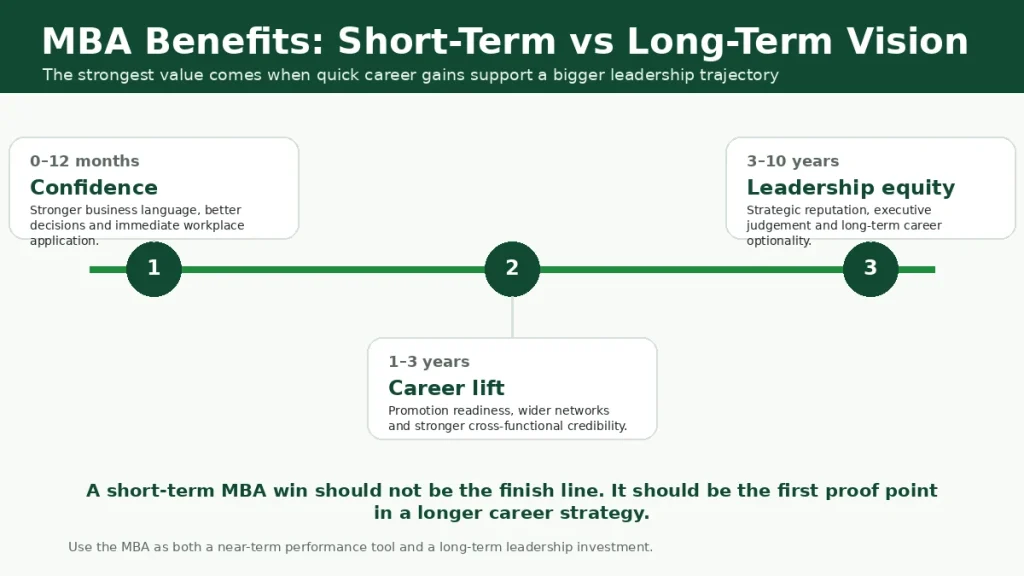
That is why MBA benefits should be understood through two lenses: short-term career gains and long-term career vision. The strongest MBA decision happens when those two are connected. Your MBA should help you perform better now, but it should also help you become the kind of leader your future requires.
The Master of Business Administration from Regenesys Business School is designed for professionals who want to strengthen business acumen, leadership capability and strategic decision-making for both immediate workplace impact and long-term career growth.
What Are the Main MBA Benefits?
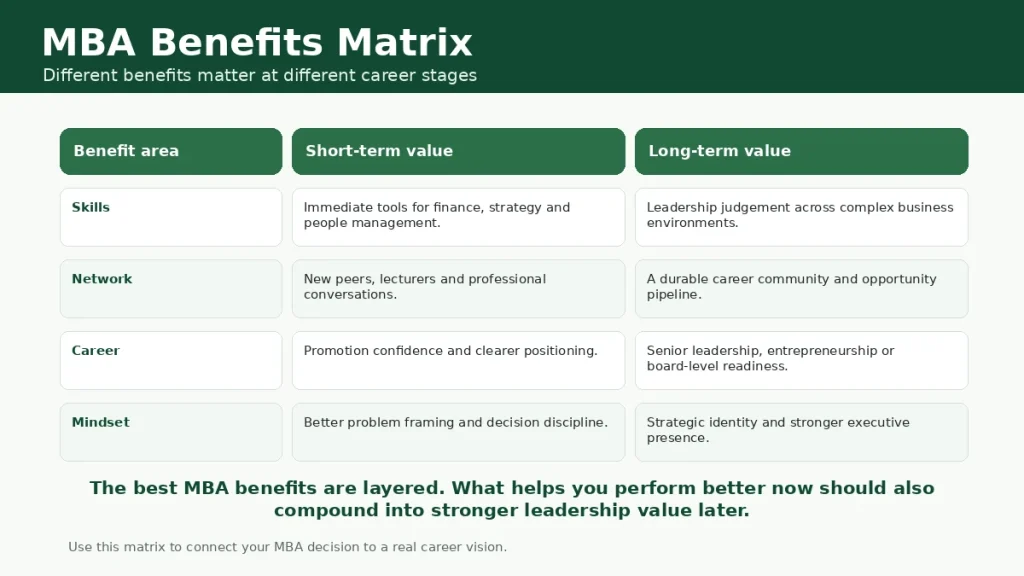
MBA benefits usually include stronger business knowledge, better leadership skills, improved career opportunities, a wider professional network and greater confidence in strategic decision-making. However, those benefits do not arrive all at once.
Some benefits appear quickly. You may become better at reading financial information, understanding business strategy, managing teams or speaking with more authority in meetings. These are short-term gains.
Other benefits take longer to mature. Your network grows. Your leadership identity becomes clearer. You begin to see business problems differently. You become more comfortable with uncertainty, complexity and long-term planning. These are long-term gains.
This is why the MBA should not be treated as a single event. It is more like a career accelerator with different returns at different stages. The real value of an MBA depends on how you use it.
A passive student may finish with a qualification. An active student can leave with stronger thinking, better relationships, practical tools and a clearer leadership direction.
Short-Term MBA Benefits: What Can Change Quickly?
Short-term MBA benefits usually appear while you are studying or shortly after completing the programme. These benefits matter because they help professionals improve performance in their current roles before the bigger career rewards arrive.
1. Stronger Business Language
One of the first benefits of an MBA is that it gives professionals a sharper business vocabulary. Many people enter management from specialist roles. They may be excellent in marketing, finance, operations, IT, HR or sales, but they may not yet understand how all areas of the business connect. An MBA helps build that broader language.
You begin to understand strategy, financial performance, operations, people management, economics, innovation and organisational change. This makes it easier to contribute in cross-functional discussions and senior-level meetings.
You stop seeing only your department. You start seeing the organisation.
2. Better Decision-Making
MBA study trains professionals to think through problems more carefully. Instead of reacting quickly, you learn to analyse context, weigh trade-offs, consider stakeholders and make decisions with stronger reasoning.
This can improve your short-term performance at work. You may ask better questions, challenge weak assumptions and present ideas more clearly.
That matters because leadership is not only about having answers. It is about improving the quality of decisions.
3. Immediate Workplace Application
A strong MBA is practical. Students can often apply what they learn directly to their current roles. A finance module can help with budgeting. A strategy module can help with planning. A leadership module can improve team management. A research project can help investigate a real business problem. This is especially useful for working professionals.
The Regenesys MBA programme includes business areas such as strategic management, financial management, marketing, operations, innovation, entrepreneurship, human resources and research. These areas are not isolated subjects. They reflect the real responsibilities leaders face in organisations.
4. Career Confidence
Many professionals already have experience but lack formal business training. An MBA can help close that confidence gap. It gives structure to what you may already know from experience. It also gives you new frameworks to understand problems you have faced before. This can make you more confident when applying for roles, leading projects or speaking to senior stakeholders.
Confidence is not a small benefit. It changes how you show up.
5. Promotion Readiness
In the short term, an MBA can strengthen your readiness for promotion. It signals that you are serious about leadership development. It also shows that you are willing to invest in your growth.
However, the MBA alone does not guarantee promotion. It must be supported by performance, communication, results and the ability to apply what you learn. The best approach is to use the MBA as evidence of growth, not as a replacement for results.
Long-Term MBA Benefits: What Compounds Over Time?
Long-term MBA benefits usually appear over several years. These are the benefits that build slowly but become powerful. They affect your leadership identity, career direction, network, strategic value and professional reputation.
1. Strategic Career Mobility
An MBA can increase your ability to move across roles, industries or functions. This matters because careers are no longer always linear. A professional may move from technical specialist to manager, from manager to executive, from corporate employee to entrepreneur or from one industry to another. The MBA gives you a broader business foundation that can support these moves.
For example, a finance professional may use an MBA to move into general management. A technical professional may use it to move into business leadership. An entrepreneur may use it to strengthen strategy, operations and financial decision-making. The long-term value is optionality. You are not locked into one narrow path.
2. Executive Thinking
An MBA can help professionals develop executive thinking over time. Executive thinking means looking beyond daily tasks. It means understanding markets, risk, people, operations, finance, technology and long-term organisational direction.
This is important because senior leaders are not paid only to complete tasks. They are paid to make judgement calls under uncertainty.
The World Economic Forum’s Future of Jobs Report 2025 highlights major shifts affecting work, including technological change, economic uncertainty and changing skill needs. This makes strategic thinking more important for leaders who must guide teams through disruption. An MBA helps professionals build the habit of looking wider and further ahead.
3. A Stronger Professional Network
The network built during an MBA can become more valuable over time. At first, classmates may simply be people you study with. Later, they may become colleagues, clients, partners, mentors, investors, suppliers or collaborators. This is one of the most underestimated MBA benefits.
Business growth often happens through relationships. A strong MBA network can expose you to different industries, leadership styles and opportunities you may not have encountered otherwise.
The value of the network depends on how actively you build it. Attending classes is not enough. You need to engage, contribute and stay connected after the programme.
4. Leadership Identity
Over time, an MBA can change how you see yourself professionally. You may start the programme as a manager, specialist or entrepreneur. But through study, reflection, group work and applied learning, you may begin to see yourself as a more strategic leader.
People often grow into senior roles only after they start thinking like senior leaders. An MBA can support that transition by giving you language, confidence and frameworks for leadership. The long-term benefit is not only what you know. It is who you become.
5. Entrepreneurial Capability
For entrepreneurs, an MBA can create long-term value by strengthening the business behind the idea. Many entrepreneurs are strong at vision but weaker in finance, operations, governance or scaling. An MBA helps build those missing muscles.
It can help entrepreneurs understand markets, manage teams, improve processes, read financial data, build strategy and make better investment decisions.
This does not mean every entrepreneur needs an MBA. But for those who want to scale, professionalise or lead more sustainably, the MBA can be a powerful long-term tool.
Short-Term vs Long-Term MBA Benefits
The difference between short-term and long-term MBA benefits is not about which one matters more. The short-term benefits help you perform better now. The long-term benefits help you build a stronger future.
| Career Vision | Short-Term MBA Benefit | Long-Term MBA Benefit |
|---|---|---|
| Skills | Better tools for immediate workplace decisions | Deeper strategic judgement over time |
| Network | New peers and professional conversations | Long-term career and business relationships |
| Confidence | Stronger voice in meetings and projects | Clearer leadership identity |
| Career growth | Promotion readiness and improved positioning | Senior leadership, entrepreneurship or executive mobility |
| Business understanding | Broader view of organisational functions | Ability to lead across complexity and change |
The best MBA candidates understand this layering. They do not study only for a salary increase. They study to build capability that compounds.
How to Build a Short-Term MBA Career Vision
A short-term MBA career vision should focus on what you want to improve in the next 12 to 24 months.
This may include:
- Becoming a better manager
- Preparing for promotion
- Moving from specialist to leadership roles
- Improving financial understanding
- Leading projects more effectively
- Building confidence with strategy
- Strengthening communication with senior leaders
- Applying business knowledge in your current role
A clear short-term vision helps you use the MBA more actively.
For example, if your goal is promotion, you can use assignments and projects to solve problems relevant to your workplace. If your goal is entrepreneurship, you can use finance and strategy modules to refine your business model. If your goal is leadership confidence, you can focus on group work, presentations and reflective learning.
The MBA becomes more valuable when you connect every module to a real career need.
How to Build a Long-Term MBA Career Vision
A long-term MBA career vision should focus on the leader you want to become in five to ten years.
This vision may include:
- Becoming a senior executive
- Starting or scaling a business
- Moving into consulting
- Leading transformation projects
- Building regional or global career mobility
- Preparing for board-level responsibility
- Becoming a stronger strategic decision-maker
- Developing thought leadership in your field
This type of vision helps you make better choices during the MBA.
You may choose electives more carefully. You may build relationships with specific classmates. You may use your research project to explore a future career direction. You may start positioning yourself as a leader in a particular industry or function. A long-term MBA vision gives your study more direction.
Without that vision, the MBA can become a collection of modules. With it, the MBA becomes a career strategy.
The MBA Benefit Most People Miss
The most overlooked MBA benefit is decision quality. People often focus on salary, title and promotion. Those matter. But the deeper value of an MBA is that it can improve how you think. Better thinking affects everything.
It changes how you analyse opportunities, manage risk, lead people, handle conflict, understand markets and respond to pressure. It helps you see the whole system instead of one isolated problem.
This is especially important in a business environment shaped by AI, hybrid work, economic pressure and rapid change.
GMAC’s Corporate Recruiters Survey 2025 notes that employers increasingly value graduate management education skills as businesses adopt new technologies. It also highlights rising interest in AI tool knowledge and the importance of GME skills in remote and hybrid workplaces.
This points to a clear career lesson: the future rewards leaders who can combine business judgement, people skills and technology awareness. An MBA can help build that combination.
Is an MBA Better for Short-Term or Long-Term Career Growth?
An MBA is usually stronger as a long-term investment, but it can produce short-term benefits when used well. The short-term benefits are useful, but they are not the full story.
If you only want a quick title change, an MBA may feel expensive and demanding. But if you want to build leadership capability that can support multiple career moves over many years, the value becomes clearer.
Think of the MBA in three layers:
The first layer is knowledge. You learn business concepts.
The second layer is application. You use those concepts in real decisions.
The third layer is identity. You become a more strategic, confident and capable leader.
The third layer takes time, but it is often the most valuable.
Who Benefits Most From an MBA?
The professionals who benefit most from an MBA are usually those who already have experience and want to move into broader leadership.
This includes:
- Middle managers preparing for senior roles
- Specialists moving into management
- Entrepreneurs who want stronger business skills
- Professionals changing industries
- Executives who want stronger strategic confidence
- Business owners who want to scale
- Technical professionals moving into leadership
- Public and private-sector managers facing complex decisions
An MBA may not be the right first step for everyone. If you are not yet ready for a full MBA, a pathway such as the Postgraduate Diploma in Business Management may help build postgraduate business capability first.
For senior professionals who want to continue beyond the MBA, the Doctor of Business Management offers a more advanced research-based business pathway.
How Technology Is Changing MBA Benefits
The MBA is also changing because business is changing. Leaders now need to understand AI, automation, data, digital transformation and the human impact of technology. This does not mean every MBA graduate must become a data scientist. But it does mean leaders must understand how technology affects strategy, operations, people and customers. This is why MBA benefits in 2026 should include future-readiness.
Professionals who want to strengthen this layer can explore related learning such as AI Leadership or AI Transformation from Digital Regenesys.
For organisations, leadership development can also be supported through Regenesys Corporate Education, which offers corporate learning solutions for teams and leaders navigating change.
The future MBA advantage will not come from business knowledge alone. It will come from combining business knowledge with adaptability, technology awareness and human leadership.
Regenesys MBA and Career Vision
The Regenesys MBA is a two-year, 230-credit NQF Level 9 programme designed to build business acumen and leadership skills. The programme covers core business areas that support both short-term and long-term career development, including strategic management, marketing, financial management, operations, entrepreneurship, innovation, human resources, conscious leadership and research. This structure matters because leadership is not built from one skill.
A strong leader must understand people, money, markets, systems, strategy and change. The MBA brings these areas together so that students can develop a more complete view of business.
For a short-term career vision, this can help improve workplace performance and promotion readiness.
For a long-term career vision, it can support executive growth, entrepreneurship, strategic leadership and broader decision-making confidence.
How to Decide If an MBA Fits Your Career Vision
Before applying for an MBA, ask yourself five questions.
First, what do I want to change in my career within the next two years?
Second, what kind of leader do I want to become in the next five to ten years?
Third, what skills am I missing right now?
Fourth, will I have the time and discipline to study seriously?
Fifth, can I connect the MBA to real work, real decisions and real relationships?
These questions matter because an MBA works best when it is connected to intention.
The professionals who gain the most are not always the smartest in the room. They are often the most deliberate. They know why they are studying, what they want to improve and how the MBA fits into a bigger life and career plan.
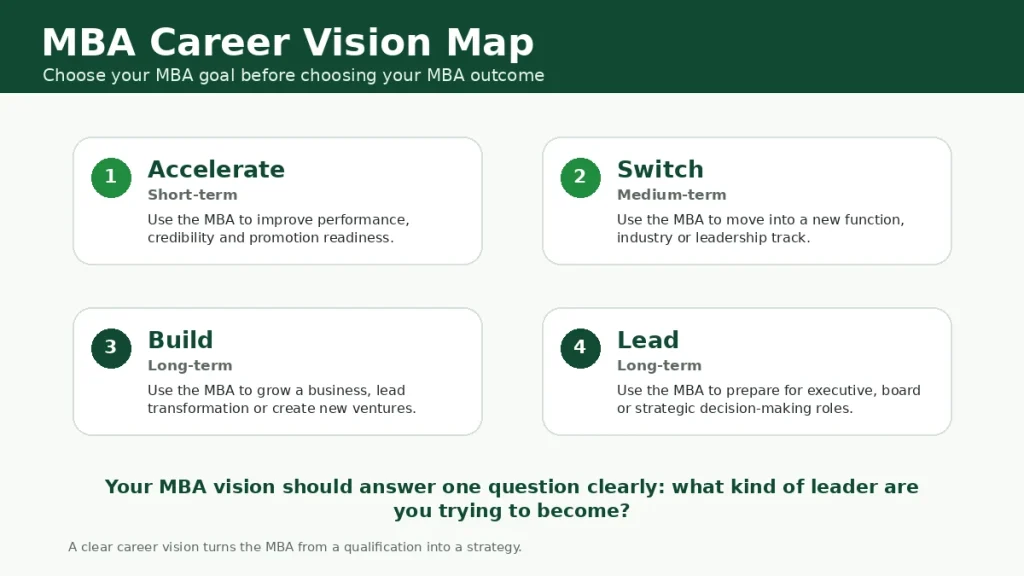
The Real MBA Advantage Is Building the Career You Cannot Yet See
The true value of an MBA is not only measured by the first promotion, the first salary increase or the first new job title. Those outcomes matter, but they are only part of the story.
The deeper MBA benefit is that it helps professionals build a stronger leadership future. It gives them broader business understanding, sharper decision-making, richer networks and a more strategic view of their own career.
Short-term gains can help you perform better now. Long-term vision helps you become more valuable over time. That is the real difference.
An MBA should not only answer where you want to go next. It should help you become ready for opportunities you cannot fully predict yet.
For professionals who want to connect immediate career growth with long-term leadership ambition, the Regenesys Master of Business Administration offers a structured pathway to build the business, leadership and strategic capabilities needed for the next stage of growth.
FAQs About MBA Benefits
What are the main benefits of an MBA?
The main MBA benefits include stronger business knowledge, leadership development, better decision-making, wider networks, career growth, improved confidence and long-term strategic capability.
What are the short-term benefits of an MBA?
Short-term MBA benefits include better business language, improved workplace performance, stronger management confidence, immediate application of learning and improved readiness for promotion.
What are the long-term benefits of an MBA?
Long-term MBA benefits include career mobility, executive thinking, leadership identity, stronger professional networks, entrepreneurial capability and better strategic decision-making over time.
Is an MBA worth it for career growth?
An MBA can be worth it when it supports a clear career vision. It is most valuable for professionals who want to move into leadership, senior management, entrepreneurship or broader strategic roles.
How does an MBA help working professionals?
An MBA helps working professionals connect theory to real workplace challenges. It can improve their ability to lead teams, understand business functions, solve problems and make better decisions.
Where can I study an MBA in South Africa?
You can explore the Regenesys Master of Business Administration, a two-year postgraduate programme designed for professionals who want to build business acumen, leadership capability and strategic decision-making skills.