Traditionally, pursuing an MBA in South Africa requires completing an undergraduate degree first. However, this is not the only pathway. Several exceptions and alternative routes are available for aspiring professionals.
Evaluating relevant work experience is one way to explore the possibility of pursuing an MBA without a traditional degree. Executive MBA programmes and alternative qualifications also offer different options for achieving this goal.
In this article, we answer the question, “Can I get an MBA without a degree?” We also highlight practical pathways for individuals who may not yet hold a bachelor’s qualification but still aspire to earn this prestigious business credential.
Table of Contents
Choosing the right MBA programme matters, and our Masters of Business Administration (MBA) courses at Regenesys are designed to help future leaders build a strong foundation for success. Enrol Now!
What is An MBA Degree?
An MBA – Master of Business Administration is a postgraduate degree that provides individuals with advanced knowledge and skills in business and management.
MBA programmes are designed to prepare students for leadership roles across various sectors of the business world. They equip students with a broad understanding of business concepts and the ability to apply strategic thinking to complex issues.
MBA programmes vary in duration, structure, and focus, and admission is typically competitive. Prospective students often need a bachelor’s degree and relevant work experience. They may be required to submit standardised test scores (such as the GMAT or GRE), letters of recommendation, and a statement of purpose as part of the application process.
Read more on What is an MBA Degree and What Does it Offer?
Key Benefits of an MBA Degree
Earning a Master of Business Administration (MBA) degree can offer a wide range of personal and professional benefits in South Africa. However, these benefits may vary depending on factors such as the reputation of the business school, an individual’s career goals, and the specific industry or job market. For this reason, prospective students should carefully consider their personal and professional objectives before pursuing an MBA programme.
Below are some of the key advantages associated with obtaining an MBA degree:
1. Enhanced Business Knowledge
- MBA programmes provide a comprehensive understanding of various business disciplines, including finance, marketing, operations, human resources, strategy, and entrepreneurship.
- This well-rounded knowledge prepares individuals for leadership roles where a broad business perspective is essential.
2. Leadership Development
- MBA programmes focus on developing leadership skills, including strategic thinking, decision-making, communication, and team management.
- Graduates are equipped to lead teams and organisations effectively.
3. Networking Opportunities
- MBA programmes provide extensive networking opportunities.
- Students interact with peers, alumni, faculty, and industry professionals. This helps build a valuable network to facilitate career advancement and business connections.
4. Career Advancement
- An MBA is often a catalyst for career advancement.
- Graduates are well-positioned for higher-level management roles, executive positions, and leadership opportunities within their chosen industries.
5. Specialisations and Expertise
- Many MBA programmes offer specialisations or concentrations. This allows individuals to develop expertise in finance, marketing, healthcare management, or entrepreneurship.
- This specialisation enhances career prospects in niche industries.
6. Entrepreneurial Skills
- MBA programmes often cultivate entrepreneurial skills, preparing individuals to start and manage their businesses.
- This includes understanding business planning, innovation, and risk management.
7. Global Perspective
- MBA programmes generally incorporate a global perspective, addressing challenges and opportunities in the international business environment.
- This global mindset is valuable in an increasingly interconnected world.
8. Critical Thinking and Problem-Solving
- MBA education emphasises critical thinking and analytical skills.
- Graduates are trained to analyse complex business problems, make informed decisions, and contribute to strategic planning.
9. Increased Earning Potential
- On average, individuals with an MBA tend to have higher earning potential than those with only a bachelor’s degree.
- The financial investment in an MBA often yields returns over a career.
10. Job Security
- The skills and knowledge gained through an MBA make individuals more adaptable to changes in the business environment.
- This adaptability enhances job security and makes MBA graduates valuable assets to organisations.
11. Opportunities for Career Switching
- An MBA provides flexibility for individuals looking to switch careers or industries.
- The broad skill set acquired allows graduates to transition into different roles and sectors.
12. Access to Alumni Networks
- MBA programmes often have strong alumni networks that provide ongoing support, mentorship, and career guidance.
- Access to this network can be valuable throughout one’s professional life.
It’s important to note that the benefits of an MBA programme can vary based on factors such as the reputation of the business school, the individual’s career goals, and the specific industry or job market. Prospective students should consider their personal and professional objectives when pursuing an MBA.
Also Read: What Is The Use Of A Master Of Business Administration?
Can I Get an MBA Without a Degree in South Africa?
An MBA is widely regarded as a key qualification for career advancement in business, management, and leadership roles. It equips professionals with advanced business knowledge, strategic thinking, and leadership skills. Naturally, many aspiring students wonder if it is possible to pursue an MBA in South Africa without holding a formal undergraduate degree.
While the traditional route to an MBA requires a recognised bachelor’s degree, the following are some alternative pathways that you can opt for:
- Work Experience Consideration: Some institutions may allow applicants with extensive professional experience, particularly in management or leadership roles, to be considered for MBA entry.
- Professional Achievements: Demonstrable success in your career, such as leading significant projects, managing teams, or running a business, can strengthen your application.
- Executive Programmes: Certain business schools offer executive MBA streams designed for experienced professionals, sometimes with more flexible academic entry requirements.
- Highly Competitive Selection: Even when alternatives exist, entry without a degree is rare and competitive. Top business schools continue to prioritise formal academic qualifications.
Although these pathways are uncommon, they demonstrate that experienced professionals may still pursue an MBA without a degree under specific circumstances. Understanding these options can help you determine whether your career profile aligns with alternative admission criteria.
Read more on Is MBA Right for Me? Understanding What the Degree Involves.
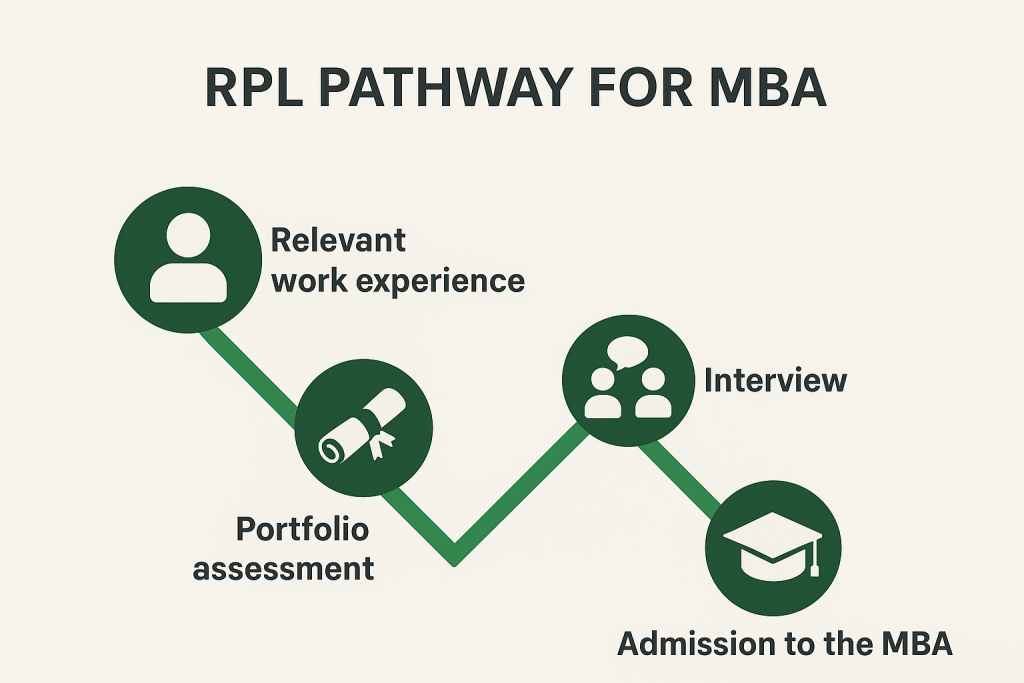
Understanding The RPL Pathway For MBA Admission
The Recognition of Prior Learning (RPL) pathway provides professionals without a traditional bachelor’s degree with an opportunity to pursue an MBA qualification. It acknowledges valuable work experience, leadership roles, and professional achievements as equivalent to formal academic learning.
Through the RPL process, candidates demonstrate their skills, competencies, and managerial experience to qualify for postgraduate study. This pathway is ideal for working professionals who have developed extensive business expertise over time and are ready to advance their careers via formal management education.
By choosing the RPL pathway, you can fast-track your journey to an accredited MBA programme and gain recognition for the skills you have already mastered in the workplace.
Read more on Best MBA Specialisations for Working Professionals.

Explore Our Other Programmes
Conclusion
An MBA without a formal bachelor’s degree is not the usual path, but it can be possible in special cases. This is especially true if you have strong, relevant work experience, clear leadership achievements, or access to RPL or executive routes. These options are competitive, so be honest about your goals, gather strong evidence of your skills, and check each school’s exact entry rules.
Regenesys Education offers an MBA – Master of Business Administration programme designed with working professionals in mind. It offers practical learning, flexible study options, and support from advisers who can explain different entry routes.
If you are curious whether your experience meets the MBA entry requirements, contact us today for personalised guidance.
FAQs
Is an MBA programme a career advancement?
An MBA is often pursued to enhance career prospects and accelerate professional growth. The MBA degree prepares graduates for higher-level management and executive positions.
Can I get an MBA without a degree?
Yes, in some cases, you can get an MBA without a degree. This is possible if you have strong work experience, leadership skills, and meet alternative entry requirements such as RPL or executive programme criteria.
What skills are gained by pursuing an MBA degree?
An MBA programme provides a well-rounded education in various business disciplines. It helps students develop essential skills like leadership, critical thinking, problem-solving, and communication.
What are the different types of an MBA programme?
There are several types of MBA programmes, typically ranging from one to two years of full-time study. The different types of MBA programmes include:
- Online MBA
- Full-Time MBA
- Part-Time MBA
- Executive MBA
- Specialised MBA
What are the common MBA specialisations?
Some of the common MBA specialisations include:
- Finance
- Marketing
- Human Resources
- Entrepreneurship
- Operations Management
- Information Technology (IT) Management and more.
Why pursue Regenesys Business School’s MBA programme?
Regenesys Business School offers a practical MBA experience tailored for individuals seeking personal and professional growth. The MBA programme is designed to equip students with the essential knowledge, skills & mindset required to succeed in the modern business landscape.