

Artificial intelligence is no longer waiting outside the legal profession. It is already inside law firms, corporate legal departments, court-support processes, contract review platforms, research tools, compliance systems and client-service workflows. The question is no longer whether AI will affect law. It already does. The real question is what kind of lawyer will remain valuable when machines can read, summarise, compare, draft, classify and retrieve information faster than any human legal team.
Table of Contents
For future lawyers, this is both exciting and uncomfortable. AI is removing some of the repetitive work that has traditionally shaped the early years of legal practice, especially research, document review, due diligence and first-draft preparation. At the same time, it is creating new expectations around legal judgement, ethics, confidentiality, client communication, data privacy and digital competence. The lawyer of the future will not stand out by trying to compete with AI on speed. They will stand out by knowing how to use AI responsibly, challenge its output, protect clients and apply human judgement where the law demands more than pattern recognition.
This is why legal education matters more, not less. Students who want to enter the profession must still understand legal principles, procedure, interpretation, evidence and ethics. However, they must also understand how technology is changing the practice of law. For aspiring legal professionals who want a strong foundation for a changing profession, Regenesys Law School offers a pathway into legal studies at a time when law, leadership and technology are becoming increasingly connected.

AI adoption in law is no longer theoretical
The Solicitors Regulation Authority has warned that AI systems are developing and spreading rapidly across the legal market. Its risk outlook noted that, by the end of 2022, three quarters of the largest solicitors’ firms were reportedly using AI, while more than 60% of large law firms were at least exploring new generative AI systems. That matters because legal AI has moved beyond experimentation. It is now becoming part of ordinary legal operations.
Recent market developments show the same pattern. In May 2026, Reuters reported that Anthropic expanded Claude’s legal tools with integrations involving Thomson Reuters, Harvey, Box, Everlaw and DocuSign. The significance is not only that another AI product entered the legal space. It is that AI is being connected directly to the platforms lawyers already use for research, documents, e-discovery and contracting. In other words, legal AI is becoming less like a separate tool and more like an invisible layer inside daily legal work.
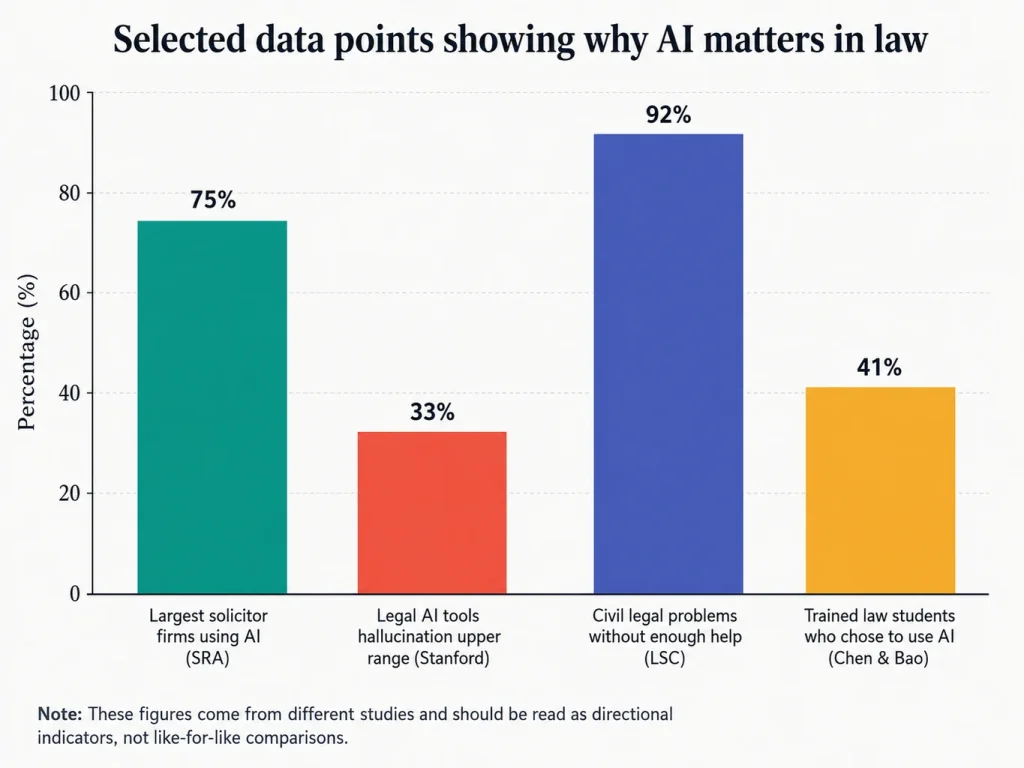
Figure 1: Selected data points showing why AI matters in law. Figures come from different studies and should be read as directional indicators, not like-for-like comparisons.
What AI is doing in law today
1. Legal research and case analysis
Legal research is one of the clearest areas where AI is changing the profession. Lawyers have always had to search through statutes, judgments, regulations, commentary and legal databases to find relevant authority. AI can now help summarise cases, identify legal issues, compare authorities, suggest lines of argument and organise research notes. This does not remove the lawyer’s duty to verify the law. It does, however, reduce the time spent on early-stage searching and sorting.
The danger is that AI can sound confident even when it is wrong. A major Stanford and RegLab study titled Hallucination-Free? Assessing the Reliability of Leading AI Legal Research Tools found that leading legal research tools still produced hallucinations in a meaningful share of answers. The authors found that specialised legal AI tools performed better than general-purpose chatbots, but they did not eliminate the risk of false or unsupported legal information. For future lawyers, the lesson is simple: AI can help you find starting points, but it cannot replace source checking, legal reasoning or professional accountability.
2. Contract review and due diligence
AI is also reshaping contract work. In commercial law, employment law, procurement, property, finance and mergers and acquisitions, legal teams often review large volumes of contracts. AI tools can identify risky clauses, compare versions, extract obligations, flag missing provisions, identify renewal dates and highlight unusual wording. This is especially useful in due diligence, where lawyers may need to review hundreds or thousands of agreements under time pressure.
The effect on future lawyers is significant. Junior lawyers may spend less time manually hunting for clauses and more time understanding why those clauses matter. Instead of only asking, “Where is the termination clause?”, the future lawyer must ask, “What does this clause mean for the client’s risk, negotiation position, regulatory exposure and commercial objectives?” That is a more valuable skill, but it requires deeper legal understanding.
3. Litigation, e-discovery and case preparation
Litigation is another area where AI is already useful. Large disputes can involve vast quantities of emails, messages, contracts, reports, meeting notes and internal documents. AI-assisted e-discovery tools help legal teams identify relevant material, group documents by issue, detect patterns, support privilege review and build chronologies. Used well, AI can make the litigation process faster and more organised.
However, courts are becoming increasingly alert to misuse. In April 2026, The Guardian reported that the Federal Court of Australia had issued new guidance warning lawyers about AI-generated errors, fictitious citations and the need to verify legal authorities. The warning is part of a wider global pattern: judges are not rejecting technology, but they are making it clear that lawyers remain responsible for what they submit to court.
4. Drafting, summarising and knowledge management
AI is increasingly used to prepare first drafts of letters, memoranda, pleadings, policies, internal notes and client updates. It can summarise lengthy documents, turn rough instructions into structured drafts and help lawyers produce clearer first versions of routine material. This can save time, especially when the task is standardised or administrative.
Yet legal drafting is not just writing. It is judgement expressed in language. A good legal document must be accurate, strategically useful, appropriate to the forum and aligned with the client’s best interests. AI can produce a draft, but a lawyer must decide whether that draft is legally correct, tactically sound and ethically safe. This is why writing skills will still matter. In fact, they may matter more, because future lawyers will need to edit, challenge and refine machine-generated text with precision.
5. Compliance, regulation and risk monitoring
AI is also helping legal teams monitor regulatory change, analyse policies and manage compliance obligations. In-house legal teams can use AI to track obligations across contracts, flag potential breaches, review internal policies and prepare risk summaries for business units. This matters because legal departments are under pressure to support faster business decisions while still protecting the organisation.
For future lawyers, this creates new career routes. The legal profession will need lawyers who understand AI governance, privacy, cybersecurity, data protection, intellectual property, procurement, platform regulation and digital risk. Lawyers who can translate complex regulation into practical business guidance will become increasingly valuable.
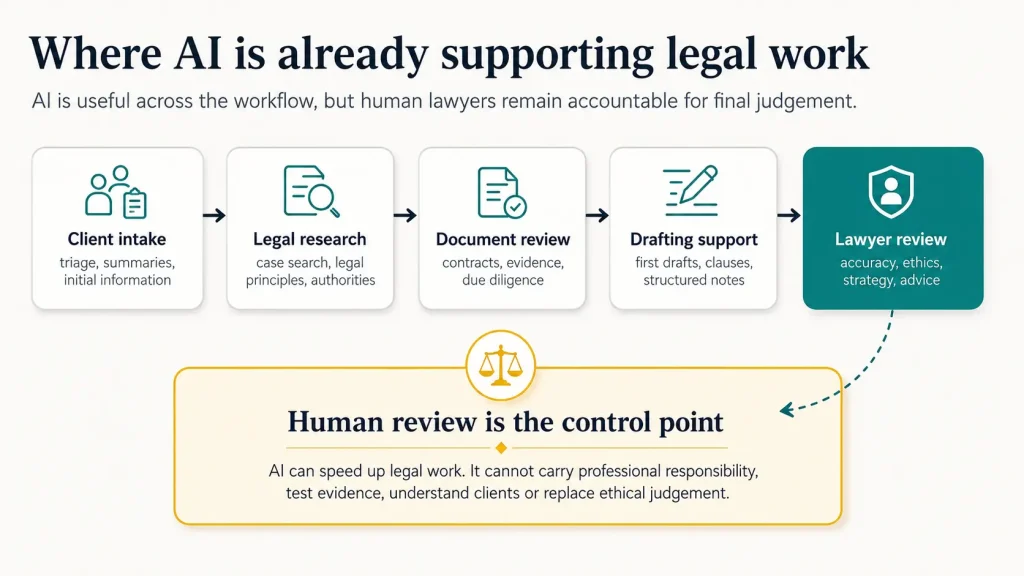
Figure 2: AI can support the legal workflow, but the lawyer remains the accountability layer.
The benefits of AI in law
The first benefit is speed. AI can produce a first-pass summary, extract clauses, organise research notes and review large document sets far faster than manual work alone. This can reduce turnaround times and allow lawyers to focus more attention on analysis and strategy.
The second benefit is scale. A human team may struggle to review thousands of documents consistently under pressure. AI can apply the same review criteria across a large dataset, then flag documents for lawyers to assess. This is useful in due diligence, compliance, litigation and regulatory investigations.
The third benefit is access to justice. Many people cannot afford legal help. The Legal Services Corporation’s Justice Gap Report found that 92% of civil legal problems reported by low-income Americans received no or insufficient legal help. AI will not solve this alone, and it must not be treated as a cheap substitute for professional legal assistance. But it can support legal clinics, public-interest organisations and advice centres by helping with triage, plain-language information, document preparation and translation. In South Africa and across Africa, where access, cost and language barriers remain real, responsible AI could help widen access to basic legal information while still keeping lawyers and qualified advisers at the centre of serious legal decisions.
The risks lawyers cannot ignore
The biggest risk is overconfidence. AI systems can produce polished answers that look authoritative but are incomplete, biased or false. In law, an elegant wrong answer can be dangerous. A fake case, an incorrect legal principle or a misleading summary can damage a client’s matter and undermine trust in the justice system.
Confidentiality is another major concern. Lawyers handle sensitive client information, personal data, business secrets and privileged material. Uploading confidential facts into an unapproved AI tool can create privacy and privilege risks. Law firms and legal departments therefore need clear policies on what tools may be used, what information may be entered, how outputs must be checked and who remains responsible for the final work.
Bias is also a serious issue. AI systems are trained on data, and legal data may reflect historic inequalities, uneven enforcement and unequal access to representation. If AI is used to predict outcomes or assess risk without careful supervision, it may reinforce unfair assumptions. Future lawyers must therefore understand not only what AI can do, but also what it may distort.
Ethics will separate strong lawyers from careless ones
The American Bar Association released its first formal ethics guidance on generative AI in July 2024, highlighting duties linked to competence, confidentiality, communication and reasonable fees. The principle is clear: AI does not weaken a lawyer’s ethical duties. It increases the need to understand them. A lawyer cannot blame a tool for a bad filing, a privacy breach, a misleading citation or poor advice.
This is why future lawyers need disciplined AI literacy. They must know how to prompt AI, but they must also know how to verify sources, identify weak reasoning, protect confidential information and explain the limits of AI to clients. AI literacy is not about becoming a software engineer. It is about becoming a safer, sharper and more responsible legal professional.
How AI affects future lawyers
The first major effect is that routine legal work will shrink. Junior lawyers have traditionally learned through repetitive research, document review, bundling and drafting. AI will reduce some of that work. This may improve efficiency, but it also means law firms and law schools must rethink training. Young lawyers still need to develop judgement, and judgement is built through exposure, supervision and reflection.
The second effect is that legal judgement becomes more valuable. If AI can prepare a first draft, the lawyer’s value shifts to knowing whether the draft is accurate, persuasive and appropriate. If AI can summarise a case, the lawyer’s value shifts to knowing whether the summary captures the real principle and how that principle applies to the client’s facts. The future lawyer will be judged less by the ability to produce more words and more by the ability to make better decisions.
The third effect is that new legal careers will grow. Future lawyers may work in legal operations, AI governance, technology regulation, privacy, cybersecurity, compliance, legal product design, contract automation, regulatory technology and legal innovation. The legal profession will still need litigators, attorneys, advocates and advisers, but it will also need lawyers who can work across law, business and technology.
The fourth effect is that clients will expect more value. If AI helps firms work faster, clients may question traditional billing models for routine work. Legal teams will need to explain where human expertise adds value and where technology has improved efficiency. This could push the profession towards clearer pricing, better client communication and more outcome-focused legal service.
What law students should learn now
Future lawyers should not abandon the fundamentals. They still need constitutional law, contract law, criminal law, delict, civil procedure, evidence, legal interpretation, ethics and legal writing. AI makes these foundations more important because a student who does not understand the law cannot properly judge whether an AI-generated answer is correct.
At the same time, students should develop practical digital competence. They should learn how AI tools generate responses, why hallucinations happen, how to verify legal information, how to use AI without breaching confidentiality and how to communicate technology risks to clients. A 2026 study on generative AI training for law students found that targeted training increased student use of AI and improved performance in an issue-spotting examination. The message is important: access to AI is not enough. Training determines whether AI becomes a shortcut or a serious professional tool.
For students thinking seriously about the profession, the best preparation is a combination of legal depth and adaptability. That means learning the law carefully, reading critically, writing clearly and staying curious about the tools that will shape legal service delivery. Students who study through Regenesys Law School can begin building this foundation in a world where legal professionals must be both principled and future-ready.
The future lawyer will be more human, not less
There is a fear that AI will make lawyers less necessary. In reality, it may make the most human parts of law more important. Clients do not only need information. They need judgement, trust, empathy, courage and strategy. They need someone who can explain risk clearly, protect their interests and make decisions under pressure. AI can support information work, but it cannot carry professional responsibility in the way a lawyer must.
The future of law will not belong to lawyers who ignore AI. It will also not belong to lawyers who blindly trust it. It will belong to lawyers who can use technology intelligently while remaining anchored in ethics, legal reasoning and human judgement. AI is changing what lawyers do, but it is not changing why lawyers matter. The legal profession exists to uphold rights, resolve disputes, protect fairness, guide society and give people access to justice. Used responsibly, AI can help lawyers do that faster and more widely. Used carelessly, it can deepen inequality, spread misinformation and weaken public trust.

For aspiring lawyers, the message is clear: do not fear AI, but do not worship it either. Learn the law deeply. Understand the technology clearly. Build the judgement to know the difference between a useful answer and a dangerous one. If you are ready to prepare for a changing legal profession, explore the programmes and pathways available through Regenesys Law School.