

Choosing the right university when pursuing information technology courses in South Africa is an important step toward building a stable career in tech. The IT field continues to grow across industries such as banking, healthcare, retail, education, and government.
Organisations need skilled professionals who understand software, data, cybersecurity, artificial intelligence and digital systems. This demand makes IT qualifications valuable to both matriculants completing their studies and working professionals seeking a career change.
In this article, we explore the top universities and institutions offering IT programmes in South Africa, the available programmes & specialisations, career opportunities, and much more.
Table of Contents
Top Universities Offering Information Technology Courses in South Africa
South Africa has several reputed universities and institutions that offer undergraduate and postgraduate IT degrees. However, not all programmes are the same. Some focus more on theory and research, while others emphasise practical learning and industry exposure. As a student, you should consider the type of skills you want to develop, the learning format, and how well the qualification prepares you for real-world roles.
Below are the top public and private institutions that offer IT programmes in the country:
1. Regenesys School of Technology
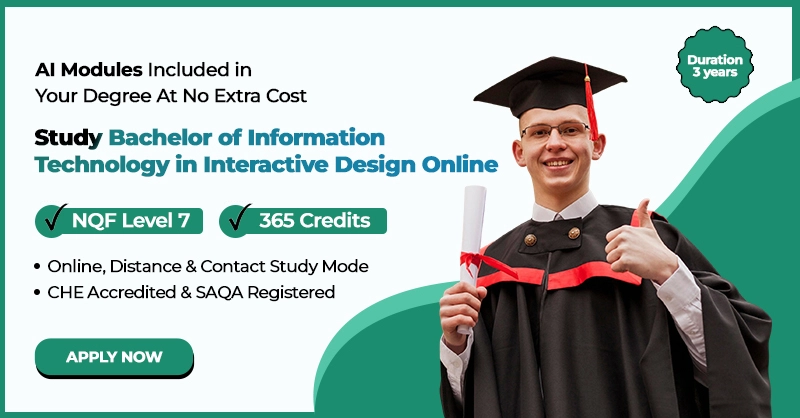
The Bachelor of Information Technology in Interactive Design programme is offered by the Regenesys School of Technology. It is a three-year degree programme with 365 credit points that combines design thinking, application development and business intelligence. It also includes AI modules at no extra cost, and focuses on project-based learning & employable skills for aspiring IT professionals.
2. University of Cape Town
The University of Cape Town offers computing and engineering degrees with strong research and practical labs. First-year students learn programming and fundamentals, while later years include modules such as databases, networks and advanced topics. UCT is often ranked highly among public universities in South Africa for science & technology subjects and has clear admissions pages and fee guides for prospective students.
3. University of the Witwatersrand
Also known as Wits, the University of the Witwatersrand provides undergraduate and honours programmes in Computer Science and Information Systems. The curriculum emphasises theory and practical applications, preparing graduates for industry roles and postgraduate study. Wits publishes detailed programme pages and a fee booklet for cost planning.
4. University of Pretoria
The University of Pretoria offers a Bachelor of Information Technology and related BSc degree programmes. These programmes cover software development, information systems, and data skills relevant to employers across sectors. The School of Information Technology at the university lists programme modules and career outcomes for students pursuing tech degrees.
5. Stellenbosch University
Stellenbosch University is another well-known university in South Africa that offers computer science and data science pathways for aspiring tech professionals. It places a strong focus on algorithms, programming, and applied computing. The university emphasises project work and provides clear guidance to prospective students on modules and admission requirements.
6. University of Johannesburg
The University of Johannesburg’s Bachelor of Science in Information Technology and Computer Science programmes combine software, informatics and maths in the curriculum. The programmes aim to prepare students for software, network & information roles and include industry links and accredited options.
7. Tshwane University of Technology
Tshwane University of Technology(TUT) offers diplomas and degrees in computer science, information technology, and systems engineering. The institution offers technical and advanced diplomas to develop hands-on skills and advanced research.
8. Vaal University of Technology
The Vaal University of Technology (VUT) provides undergraduate and postgraduate information & communication technology programmes. It focuses on applied research in areas such as artificial intelligence, machine learning, and data science. The faculty supports workplace-ready skills and research supervision for higher degrees.
Read more on Where Can I Study Information Technology in South Africa?
Key Factors To Consider When Choosing An Educational Institution
When you compare options, focus on quality, practical exposure and career support. Choose a programme that aligns with the kind of job role you are targeting. For example, it could include development, UX and design, or data and artificial intelligence.
Check whether the programme includes industry projects, internships or a final-year project, as they can help you build a portfolio. Also confirm accreditation, delivery format (campus or online), and available student support services. Finally, review the clear entry requirements to plan your application.
Read more on How to Become an IT Specialist – Skills & Qualifications.
Popular Information Technology Courses & Specialisations
Many educational institutions in South Africa offer a core IT degree with options to specialise. Common choices include software development, design thinking, information systems, industrial psychology, data science, cybersecurity and interactive design. Specialisations often define the electives and projects you will complete across years two and three.
If you want visual, user-centred work, interactive design degrees, such as the one offered by Regenesys School of Technology, combine UI/UX, front-end development and prototyping. For data roles, choose programmes or modules that include statistics, machine learning and data visualisation.
Read more on IT Degrees in South Africa – Best Options for 2026.

Admission Requirements & Application Process
Entry rules vary across institutions, but most undergraduate IT degrees require a National Senior Certificate (Matric) with a bachelor’s pass or equivalent. Some institutions expect minimum marks in mathematics or a related subject at the grade 12 level, while others accept bridging tests or recognised diplomas.
International applicants should check the institution’s official website for visa and credential requirements. Apply through the institution’s admissions portal, meet deadlines and gather certified documents, transcripts and ID.
Regenesys Education lists clear entry criteria for the Bachelor of Information Technology in Interactive Design degree on its programme page.
Read more on IT Career Path After Higher Certificate – Explore!
Tuition Fees & Financial Aid Options
Tuition fees vary by institution, programme, and residency status. Public universities publish annual fee schedules and fee booklets, while private institutions list fees on the programme page or in the brochure. For many students in South Africa, the National Student Financial Aid Scheme (NSFAS) is a key source of bursary support for eligible learners.
You can also check each institution’s website for scholarships, institutional bursaries, and payment plans. For example, you can get student funding from Regenesys Education when you enrol in any of our programmes.
Career Opportunities After An IT Degree In South Africa
An IT degree opens up many entry-level roles, including software developer, systems analyst, UI/UX designer, data analyst, and IT support specialist. Graduates with interactive design skills can work in product teams, digital agencies or startup design roles.
Employers value practical project work, internship experience and demonstrable skills in coding, design tools or data tools. Regenesys Education provides career guidance and lists typical graduate pathways for the Interactive Design degree. Make sure to continue building your portfolio and learning new tools after graduation to ensure smooth career progression.
Read more on Top 10 IT Jobs in South Africa.

Explore Our Other Programmes
Conclusion
Choosing the right university or educational institution to study information technology courses in South Africa involves balancing reputation, practical learning, costs and career goals. Public universities offer established research and broad campus services while private institutions like Regenesys School of Technology provide applied, industry-focused training and flexible delivery.
If you want to pursue a degree that combines design, development and business intelligence with AI modules included at no additional cost, consider the Bachelor of Information Technology in Interactive Design programme.
Visit the Regenesys Education website and explore the programme page for details.
You can also contact us to speak with a career adviser and plan your career pathway.
FAQs
What are the admission requirements for information technology courses in South Africa?
Most IT degrees require a Matric certificate with a bachelor’s pass. Additional requirements include English proficiency, APS score and minimum marks in mathematics or mathematical literacy. Check each institution’s programme page for more information.
Which universities in South Africa offer the best IT programmes?
Universities and private institutions renowned for their IT programmes include Regenesys School of Technology, the University of Cape Town, the University of the Witwatersrand, the University of Pretoria, Stellenbosch, and the University of Johannesburg.
What IT specialisations are available in South African universities?
You will find specialisations such as software development, design thinking, information systems, industrial psychology, IT governance and risk management, data science, cybersecurity, and interactive design.
How much does it cost to study IT in South Africa?
Fees vary widely by institution. Contact each university or private institution, or check their programme brochures and fee booklets for accurate information.
What career opportunities can I expect after completing an IT degree in South Africa?
IT graduates commonly join roles such as software developer, systems analyst, UX designer, data analyst or information technology project roles.