

The price of an AI course can look confusing because the word “AI” is used for almost everything now. One course may cost nothing and teach you the basics of prompt writing. Another may cost a few hundred rand and give you a short certificate. A structured online course may run for several months with live sessions, projects and career-focused support. A formal occupational or accredited programme may require a much bigger investment because it is designed to build deeper, job-ready capability.
Table of Content
So, when people ask, “How much do AI courses cost?”, the honest answer is this: AI courses can cost anywhere from free to tens of thousands of rand, depending on the provider, duration, support, qualification level and the outcome you want.
But price alone is not the best question. The better question is: what will you be able to do after the course? That is where the real value sits. A cheap AI course may be useful if you only want awareness. But if you want to build AI-powered applications, prepare for a technology career or upskill a team, you need more than videos and buzzwords. You need practical learning, projects, feedback and a clear path from knowledge to application.
For learners who want to build career-focused capability, the Artificial Intelligence Software Developer programme offers a practical route into AI software development and intelligent application building.
What Is the Average Cost of an AI Course?
The average cost of an AI course depends on the type of course you choose.
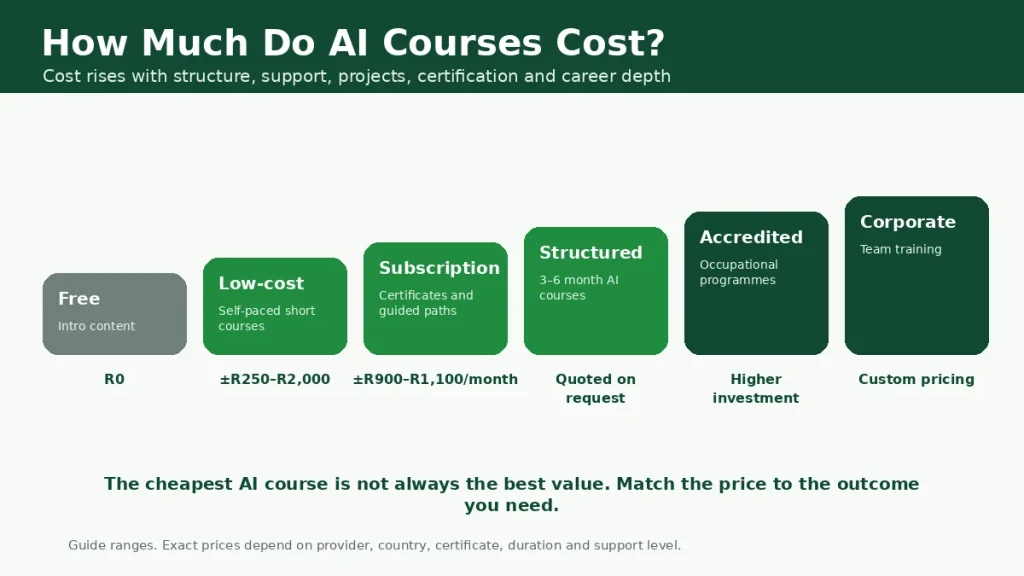
As a general guide, AI course costs can be grouped like this:
| Type of AI Course | Estimated Cost Range | Best For |
|---|---|---|
| Free AI tutorials and short introductions | R0 | Basic awareness |
| Low-cost self-paced courses | ±R250 – R2,000 | Beginners exploring AI |
| Subscription-based AI certificates | ±R800 – R1,100 per month | Flexible online learning |
| Structured 3–6 month AI courses | Often quoted on request | Practical upskilling |
| Accredited or occupational programmes | Higher investment | Career-focused development |
| Corporate AI training | Custom pricing | Teams and organisations |
These ranges are not fixed. They are planning estimates based on current public pricing across major learning platforms and AI course models.
For example, Coursera Plus lists a monthly subscription option and an annual plan, while the Google AI Professional Certificate is priced through a monthly subscription model in selected regions. edX allows learners to audit many courses for free and pay for verified certificates, while some professional certificate programmes cost more because they bundle multiple courses.
The important lesson is simple: AI course pricing is linked to learning depth. A short AI awareness course should not cost the same as a practical developer programme. A self-paced video course should not be compared directly with a course that includes live teaching, practical projects, feedback, career support or recognised certification.
Why AI Course Prices Vary So Much
AI course prices vary because AI training is not one thing. Some courses teach basic AI literacy. These help learners understand what AI is, how generative AI works and how tools such as chatbots can support everyday productivity.
Other courses teach practical workplace AI. These may cover prompt engineering, automation, AI tools, data handling and responsible use.
Then there are technical AI courses. These often include Python, machine learning, data preparation, model evaluation, APIs, software development and deployment. These cost more because they require deeper teaching, more practice and stronger support.
Finally, there are career-focused and accredited programmes. These are designed to help learners build capability that can lead to employment, promotion or professional advancement. They usually require more time, assessment and structured learning.
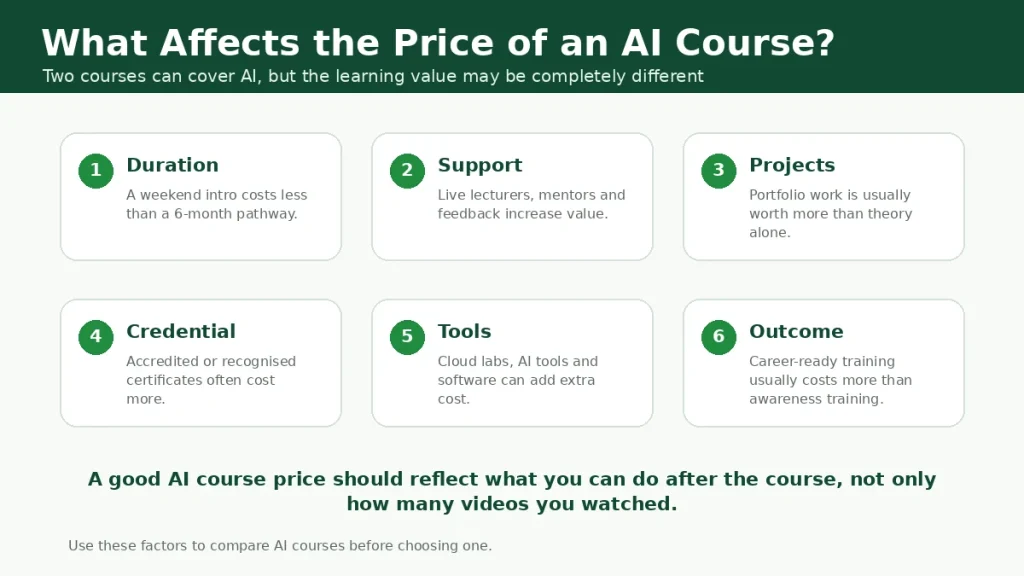
The price difference often comes down to six factors:
- Duration
- Lecturer or mentor support
- Practical projects
- Certification or accreditation
- Tools, labs and software access
- Career or business outcome
A course with no support, no projects and no assessment should be cheaper. A course with live sessions, guided practice, recognised certification and real-world projects will naturally cost more. This is why comparing AI courses only by price can be misleading.
Free AI Courses: Are They Worth It?
Free AI courses can be useful, especially if you are just starting. They are good for understanding basic concepts, learning vocabulary and exploring whether AI interests you. Free learning can also help you avoid paying for a course before you know what you want.
Platforms such as Microsoft Learn offer AI learning resources, and many providers publish free introductions, tutorials and webinars.
Free courses are best for:
- Understanding what AI is
- Learning basic AI terms
- Exploring generative AI tools
- Testing your interest
- Building confidence before paying
However, free courses usually have limits.
They may not include a recognised certificate. They may not include feedback. They may not include practical projects. They may also lack structured progression, which can make it hard for beginners to know what to learn next.
Free courses are a good starting point, but they are rarely enough if your goal is to become job-ready.
Low-Cost AI Courses: What Do You Usually Get?
Low-cost AI courses are often self-paced and video-based. These may cost a few hundred rand to a few thousand rand, depending on the platform and promotion. A low-cost AI course can be a smart choice if you want quick exposure to a topic such as prompt engineering, generative AI, Python basics or AI tools for business. These courses are useful when they are practical, focused and completed properly.
The risk is that many low-cost courses are easy to buy and easy to abandon. A learner may collect certificates without building real skill.
Before buying a low-cost AI course, ask:
- Does it include projects?
- Is the content current?
- Does it teach practical tools?
- Are there exercises?
- Is the instructor credible?
- Will I be able to apply this at work?
A cheap course only becomes valuable when you complete it and use what you learned.
Subscription-Based AI Courses
Subscription-based AI courses usually charge monthly or annually. This model is common on global online learning platforms. For example, Coursera Plus gives access to many courses through a subscription, while DataCamp offers subscription-based access to data, coding and AI-related learning.
Subscription models can be affordable if you learn consistently. They become expensive when you pay every month but do not complete the course.
This is the hidden cost of subscription learning: time drift. A course that costs about R900 per month may seem affordable. But if a learner takes six months to complete something that could have been completed in two months, the real cost increases.
Subscription-based AI courses are best for self-disciplined learners who can study regularly and finish within a clear timeframe.
Structured AI Courses: Why They Cost More
Structured AI courses usually cost more because they offer more than content.
A structured course may include:
- A clear curriculum
- Live or guided sessions
- Practical assignments
- Tools and project work
- Lecturer or facilitator support
- Assessments
- Certification
- Peer learning
- Career or workplace relevance
This structure matters because AI can be difficult to learn alone. Beginners often get lost between prompt engineering, Python, machine learning, data science, automation, generative AI, AI agents and software development.
A structured course helps learners move in the right order. For example, the Digital Regenesys Artificial Intelligence Course is a 6-month online course with live and self-paced learning. It focuses on practical AI skills, building intelligent systems, automating tasks and working with data using popular AI tools.
That type of course is different from a short video tutorial. It is built for learners who want a guided experience and a practical learning outcome.
Accredited and Career-Focused AI Programmes
Accredited or occupational AI programmes usually require a higher investment because they are designed around deeper skill development. These programmes may include formal assessment, credit-bearing learning, practical workplace relevance and recognised standards. They are usually better suited to learners who want to build a career pathway rather than simply understand AI at a surface level.
The Occupational Certificate: Artificial Intelligence Software Developer from Regenesys Skills Academy is an example of a career-focused AI programme. It is an 18-month qualification with SAQA ID 118792, NQF Level 5, 209 credits and QCTO accreditation.
This type of programme is designed for learners who want to build practical AI software development capability. It focuses on skills such as building AI functionality into software applications, creating and testing code, integrating machine learning APIs and solving real-world problems. That is a very different outcome from simply learning how to use AI tools.
If your goal is career development, the higher investment may make sense because you are paying for depth, structure and recognised learning.
Corporate AI Training Costs
Corporate AI training is usually priced differently from individual courses. A business may need to train a team, department or leadership group. The cost depends on group size, learning goals, duration, customisation, delivery format and whether the training includes strategy, implementation support or technical projects.
Corporate AI training may focus on:
- AI literacy for employees
- AI tools for productivity
- AI for managers
- AI governance
- AI strategy
- AI software development
- Data and automation
- Responsible AI
- AI transformation
For organisations, the question should not only be, “How much does the course cost?” The better question is, “What business problem will this training help us solve?” If training helps a team automate reporting, improve customer response time, reduce manual work or use data better, the return can be far greater than the course fee.
Organisations looking to build AI capability across teams can explore Regenesys Corporate Education, which focuses on helping businesses develop AI fluency and applied capability.
Hidden Costs to Consider Before Choosing an AI Course
The advertised course fee is not always the full cost.
Before choosing an AI course, consider these possible hidden costs:
1. Software and Tool Costs
Some AI courses require paid tools, cloud credits, coding environments or AI platform subscriptions. Others provide access as part of the course. Always check whether tools are included.
2. Certificate Fees
Some platforms allow free learning but charge for verified certificates. This is common in online education. If you need proof of completion, check the certificate cost before enrolling.
3. Data and Internet Costs
AI courses often include videos, live sessions, coding environments and cloud-based tools. Learners should consider connectivity costs, especially if the course runs over several months.
4. Time Cost
Time is the biggest hidden cost. A free course that takes months and leads nowhere can be more expensive than a paid course that helps you build practical skills quickly.
5. Renewal or Subscription Costs
Subscription-based platforms can keep charging until cancelled. Learners should know the billing cycle and complete the course within a planned timeframe.
6. Opportunity Cost
If you choose the wrong course, you may lose time that could have been spent building job-ready skills. This is why course selection matters.
How to Know If an AI Course Is Worth the Cost
An AI course is worth the cost when it helps you achieve a clear outcome. For a beginner, that outcome may be understanding AI and using tools confidently. For a working professional, it may be applying AI to improve productivity. For a developer, it may be building AI-powered applications. For a business, it may be developing team capability.
A good AI course should help you answer:
- What will I be able to do after this course?
- Will I build practical projects?
- Is the content current?
- Is there support?
- Is the certificate recognised?
- Does the course match my career or business goal?
- Will I learn tools, concepts and application?
- Can I show proof of skill after completing it?
The best AI course is not always the cheapest. It is also not always the most expensive. It is the one that gives you the strongest connection between cost, learning support and practical outcome.
How Much Should Beginners Spend on an AI Course?
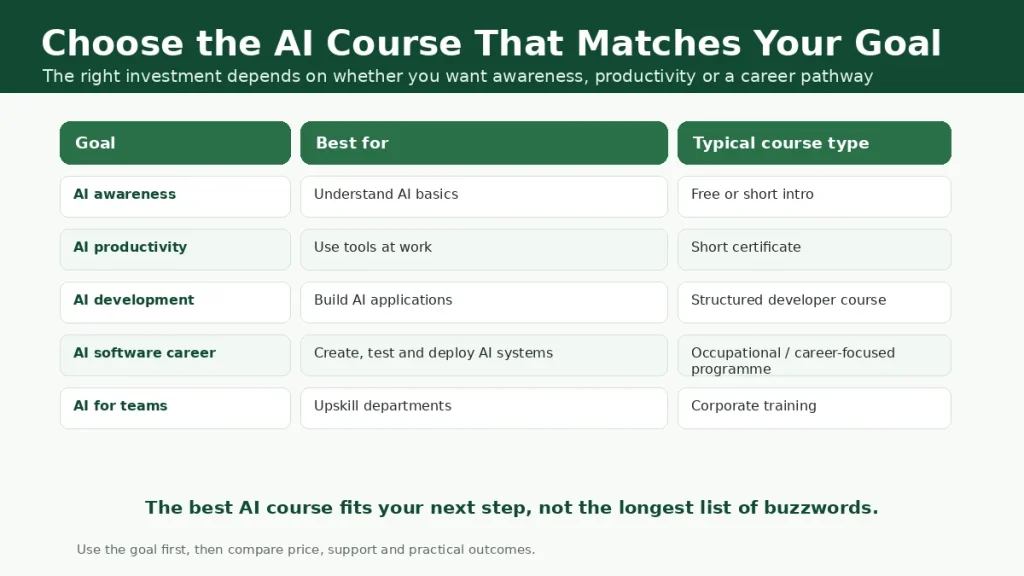
Beginners should not start by spending the most money possible. A smart beginner pathway could look like this: Start with free AI resources to understand the basics. Then take a short course to test your interest. After that, choose a structured or career-focused programme if you want deeper skills. This approach reduces risk.
If you only want to use AI tools for productivity, a short certificate may be enough. If you want to become an AI developer or software professional, you will need a stronger pathway.
Learners who want to move into practical AI development can explore the AI for Developers programme from Regenesys School of AI. Those who want a broader introduction to AI can also review the Regenesys School of AI.
AI Course Cost vs Career Value
The value of an AI course should be measured against future capability, not only current affordability. AI skills are becoming important across industries. Businesses need people who can understand AI, apply tools responsibly, automate tasks, work with data and build intelligent systems.
This does not mean every AI course will lead to a job. It means learners should choose courses that build skills employers and businesses can use.
For career-focused learners, the most valuable AI courses usually include:
- Practical projects
- Coding or tool-based work
- Business use cases
- Data understanding
- Testing and evaluation
- Responsible AI
- Certification or recognised learning
- A clear progression path
A course that builds these capabilities may cost more, but it can also create stronger long-term value.
The Real Cost of an AI Course Is What It Helps You Build
AI courses do not all cost the same because they do not all offer the same value. A free course can help you start. A low-cost course can help you explore. A subscription certificate can help you learn flexibly. A structured course can help you build practical skills. An accredited or occupational programme can help you prepare for a career pathway. The right choice depends on your goal.
If you only want to understand AI, you do not need the most advanced programme. If you want to use AI at work, choose a course with practical tools and workplace examples. If you want to become an AI software developer, choose a programme that builds coding, AI, testing and problem-solving capability. The smartest investment is not the cheapest course. It is the course that moves you closer to the outcome you actually want.
For learners ready to build practical AI software development skills, the Artificial Intelligence Software Developer programme offers a structured path into one of the most important skill areas of the AI era.
FAQs About AI Course Costs
How much do AI courses cost?
AI courses can cost anywhere from free to tens of thousands of rand. Short online courses may cost a few hundred rand, subscription certificates may cost around R800 to R1,100 per month, and structured or accredited programmes usually require a higher investment.
Are free AI courses worth it?
Yes, free AI courses are useful for beginners who want to understand basic concepts. However, they may not include certificates, projects, support or career-focused training.
Why are some AI courses expensive?
Some AI courses cost more because they include live teaching, practical projects, assessments, recognised certification, mentor support, technical tools and deeper career-focused learning.
What is the cheapest way to learn AI?
The cheapest way to start is with free resources and short self-paced courses. However, learners who want career-ready skills may eventually need structured training, projects and certification.
Should I choose a short AI course or a longer programme?
Choose a short AI course if you want awareness or productivity skills. Choose a longer programme if you want to build AI applications, work in technology or develop a career pathway.
Where can I study AI software development?
You can explore the Artificial Intelligence Software Developer programme from Regenesys Skills Academy. It is designed for learners who want practical AI software development skills and a structured, career-focused learning pathway.