

Healthcare leaders are being sold a seductive story about AI. The story says that if you adopt the right tools, transformation will follow. Diagnosis will become faster. Care will become more personalised. Waste will fall away. Operational friction will ease. Patients will benefit. Systems will become more intelligent almost by default. But healthcare is not transformed by tools. It is transformed by systems.
That distinction matters, especially now. Across South Africa and beyond, healthcare institutions are under pressure to do more with less while improving quality, widening access, controlling costs and managing rising complexity. In that environment, AI is often presented as the answer. In truth, it is only useful when leaders know how to move it from experimentation to execution, from isolated innovation to system-wide impact. That was one of the clearest themes to emerge from the Regenesys AI Summit healthcare discussion on scaling AI-driven healthcare.
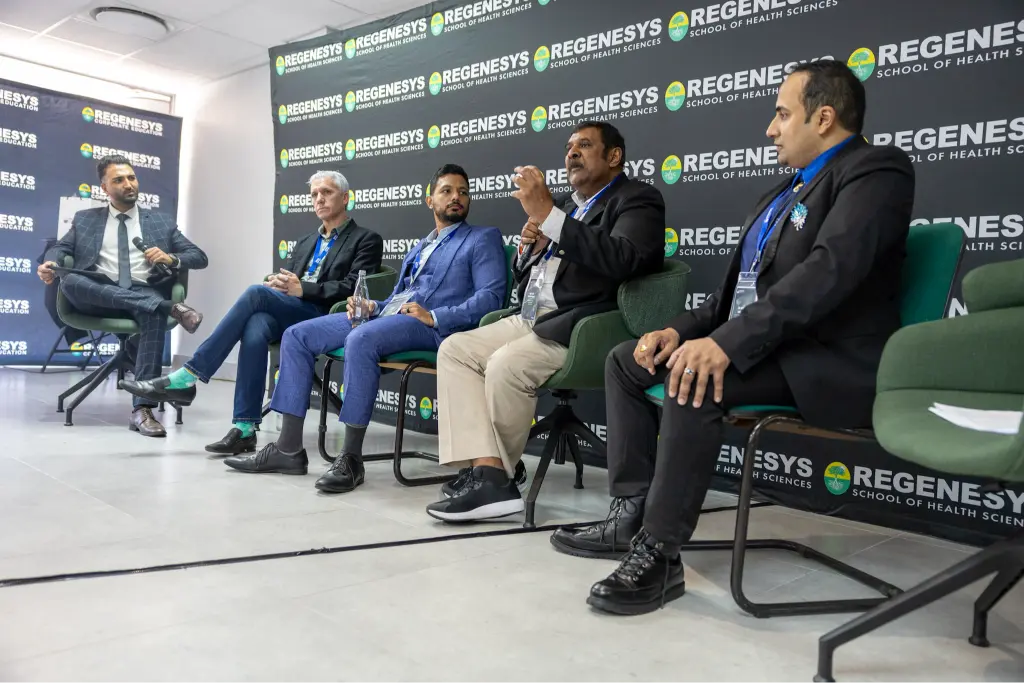
The conversation brought together leaders from across healthcare, pharmaceuticals, information technology and medical funding, adding real depth to the discussion around scale, ethics and system-wide impact. Featured speakers included Dr Rowen Govender of Regenesys Education, Gloseije Bazolana of the NICD, Sekhar Subramoney of Aptus Data Labs, Johan Alberts, Reven Singh of InterSystems, and Quantin van Rensburg of Platinum Health Medical Scheme.
What made the conversation compelling was not the usual excitement around AI’s potential. It was the sober recognition that the hardest part is not creating the model. It is deploying it responsibly, integrating it into the real world, and ensuring that it improves access, efficiency and patient outcomes at scale.

Why Scaling AI In Healthcare Matters More Than Another Pilot Project
Healthcare is not short on ideas. It is short on scaled execution. That is the uncomfortable truth many institutions are now confronting. The sector has moved well past the point where AI can be treated as a futuristic concept. The underlying science is decades old. The industry has already lived through phases of automation, prediction and machine learning, and is now in the era of generative AI, with agentic systems and robotics rapidly approaching the mainstream.
For executives, the implication is significant. AI is no longer a side conversation for innovation teams. It is becoming a leadership question. The organisations that will gain the most from it are not necessarily those with the flashiest demos or the loudest claims. They are the ones that can embed AI into care pathways, administrative processes, risk management, and decision-making in ways that are measurable and sustainable.
This is where many strategies fall apart. A proof of concept on a laptop is not transformation. A successful pilot in one unit is not scale. A clever dashboard is not system redesign. Healthcare AI only becomes meaningful when it moves beyond isolated wins and starts reshaping how the organisation actually functions.
The Real Competitive Edge In Healthcare AI Is Not The Model. It Is The Data
Every C-suite conversation about AI eventually lands in the same place: capability. Do we have the right people? Do we have the right technology? Do we have the right infrastructure?
Those questions matter, but the conversation points to something even more decisive. The true differentiator is the dataset. The speaker identified three foundational requirements for meaningful AI adoption: skilled people, powerful technology, and unique data, with the strongest emphasis placed on data as the element that allows an organisation to use AI in ways competitors cannot easily replicate.
That insight should not be underestimated. In healthcare, data is not merely an operational record. It is the raw material for better judgement. Claims histories, pathology, imaging, treatment pathways, call centre interactions, blood results, disease progression and outcomes create a picture of the patient journey that can unlock more precise, more timely and more effective interventions when used well.
This is especially relevant in South Africa, where healthcare providers, funders and public health institutions operate in a market shaped by unequal access, cost pressure, and growing demand. In that environment, the organisations that know how to harness their own data responsibly will be better placed to build AI that reflects local realities rather than imported assumptions.
Better Patient Outcomes Depend On AI That Supports Decisions, Not Just Automation
The strongest clinical example in the discussion came from oncology, and for good reason. Cancer care is one of the most complicated environments in modern medicine. There are more than 200 different cancers, multiple subtypes, thousands of genomic variations, and numerous treatment permutations shaped by timing, cost, toxicity, surgery, radiation, medicine and quality-of-life considerations.
This is exactly the kind of complexity that exposes whether AI has real value or merely creates the illusion of intelligence.
The oncology use case described a system that builds “clinical twins”, finding patients with similar diagnoses and characteristics, analysing their journeys, and identifying which treatment paths delivered the strongest outcomes. Importantly, those outcomes are not limited to survival. They include quality of life, side effects and financial implications. That is a far more strategic use of AI than simple automation. It supports clinicians with richer evidence, enables more personalised treatment thinking, and brings decision-making closer to the realities patients actually live with.
For leaders, the lesson is clear. AI in healthcare becomes powerful when it sharpens judgement. The real opportunity is not merely speeding up tasks. It is helping clinicians and systems make better decisions with greater confidence.
Why AI Healthcare Efficiency Is Not Just An Admin Issue
One of the biggest mistakes in healthcare strategy is treating efficiency as somehow less important than clinical excellence. In practice, the two are deeply connected.
The conversation shows that before AI could be used to strengthen oncology decision support at a more advanced level, it first had to solve internal administrative complexity. A process that once involved nine separate administrative steps was streamlined significantly using AI.
That matters because slow administration in healthcare is never neutral. It delays treatment approval, drains specialist attention, creates frustration for clinicians and patients, and adds cost to the system. Leaders who dismiss administrative AI as low-value are missing the point. In healthcare, operational friction often determines whether clinical value can be delivered at the right moment.
This is why scaling AI in healthcare must include workflow redesign, not just innovation showcases. Efficiency is not a secondary win. In many cases, it is the mechanism that makes better care possible.
Fraud, Waste And Leakage Are Healthcare AI Problems Too
Thought leadership on AI in healthcare often defaults to the most glamorous use cases: robotic surgery, diagnostics, precision medicine and virtual assistants. Those matter, but they are not the only frontiers worth watching.
Fraud detection may not sound visionary, yet its impact on system sustainability is enormous. The panel discussion described how AI was used to detect fraudulent provider syndicates in the medical scheme space, including complex networks involving pharmacies, physiotherapists, GPs and members operating together. Using classifiers and graph neural networks, the system could identify clusters and trace fraudulent behaviour at scale. The reported fraud recoveries ran into hundreds of millions of rand, with the speaker noting that this still likely represented only a fraction of the true total.
This matters for one simple reason: healthcare systems do not improve through clinical innovation alone. They improve when resources are protected. Every fraudulent claim weakens affordability, drains capacity and indirectly undermines patient access. AI that protects the financial integrity of the system is therefore not peripheral to better outcomes. It is part of them.
The Future Of AI In Healthcare Will Be Won Or Lost On Ethics
The most serious leadership issue raised in the panel discussion was not technical at all. It was ethical.
The discussion around predictive modelling for advanced illness care made that impossible to ignore. Using AI to identify patients likely to die within a certain period opened the door to earlier conversations, more dignified home-based care, lower costs, and better support for families. The programme was presented not as a cold cost-saving exercise, but as a way of improving comfort and dignity at the end of life while reducing repeated hospital admissions and invasive interventions.
Yet this use case also exposes the moral weight of healthcare AI. What happens when the model is wrong? How should such insight be communicated? What is the emotional toll on nurses, doctors and families? Is the organisation acting in the patient’s best interests, or primarily in the interest of cost control? The panel discussion makes clear that these were not abstract questions. They required deep internal debate, collaboration with clinical societies, and careful attention to responsibility, communication and trust.
This is where many AI strategies still feel immature. They focus heavily on technical performance and far too lightly on organisational ethics. In healthcare, model accuracy is not enough. Leaders need governance frameworks, clinical guardrails, escalation processes and a clear philosophy for how AI should intersect with human dignity.
That is not a compliance exercise. It is a leadership obligation.
What South African Healthcare Leaders Should Be Asking Now
South Africa has a genuine opportunity here, but only if leaders resist the temptation to chase AI theatre.
The question is not whether AI can be used in healthcare. It already is. The real questions are harder and more useful. Where can it improve outcomes without introducing new forms of harm? Where can it reduce bottlenecks that limit access? Where can it support clinicians without displacing accountability? Where can it strengthen system sustainability, not just create isolated points of intelligence?
The panel discussion offers a practical framework, even if indirectly. Start with the foundations. Invest in the right people. Build the engineering and systems capability needed for real deployment. Treat data as a strategic asset. Solve operational friction. Focus on the customer or patient experience, not only the model. And never separate technical progress from ethical responsibility.
This is the shift C-suite leaders need to make. AI should no longer sit in the organisation as a collection of experiments. It should be governed as a strategic capability with implications for care delivery, financial sustainability, workforce design, risk management and long-term competitiveness.



Healthcare AI Must Move From Fascination To Infrastructure
There is a reason so many AI conversations remain underwhelming. They are obsessed with what the technology can do, but far less rigorous about what institutions must become in order to use it well.
That is the real story in healthcare.
Scaling AI in healthcare is not about sprinkling intelligence across existing dysfunction and hoping for better results. It is about rethinking systems so that intelligence can actually improve them. It is about marrying innovation to execution, data to judgement, and efficiency to patient value. It is about recognising that the biggest breakthrough will not come from the model alone, but from the institution that knows how to deploy it with discipline, humanity and purpose.
The leaders who understand that will do more than adopt AI.
They will shape the future of healthcare with it.