
The matric exams are the most critical papers that students in South Africa appear for in their final year of schooling. Their scores on these exams determine their future educational paths and the programmes they will be eligible for at university. Understanding the structure of the exams and how the marks are calculated can better prepare students to appear for the examinations. It can help them calculate how much time to dedicate to each subject.
This article will explain how are matric final marks calculated, how much is needed to pass, and how you can calculate your scores.
Table of Contents
Introduction to Matric Final Marks Calculation
The matric exams are formally known as the National Student Certificate (NSC) exams, and students in South Africa are required to appear for them to pass matric or grade 12. Students who pass these exams are awarded an NQF level 4 (National Qualification Framework) qualification.
The matric final marks are the most important scores for students preparing to further their higher education. Once you understand how are matric final marks calculated, you will be able to understand your scores. The score on the matric exams indicates whether a student is equipped for a degree programme, a certificate course, or vocational training. They also signify that a student has passed grade 12, but the process does not end there.
These marks are then converted to an Admission Point Score (APS), which universities use as an eligibility criterion during the application process. A higher score on the matric benefits students by allowing them to apply for a major of their choice.

How are Matric Final Marks Calculated?
The matric exam marks are calculated based on School-Based assessments (SBA) and the final exams. The SBA accounts for 25% of the final score, and the exams account for 75%. Students must score well during the exam since it contributes to most of the final score.
The SBAs comprise assignments, tests, and exams that students must complete during the school year. The only exception is Life Orientation, which is completed based on the SBA score.
When students try to determine how matric final marks are calculated, they need to understand the tiered-level scoring system of the matric exams. In this system, a score below 29% means a fail for the subject. The table below will help students understand the percentage scores required to ace the exams.
|
Percentage |
Achievement |
|
80 – 100% |
Outstanding achievement |
|
70 – 79% |
Meritorious achievement |
|
60 – 69% |
Substantial achievement |
|
50 – 59% |
Moderate achievement |
|
40 – 49% |
Adequate achievement |
|
30 – 39% |
Elementary achievement |
|
0-29% |
Fail |
How Much is Needed for Matric Pass?
The score that a student receives for each subject is calculated to determine what level of pass they have achieved. These pass levels are Bachelor, Diploma, Higher Certificate, or NSC pass. The pass level allows students admission into the undergraduate programme of their choice.
Now that we understand how matric final marks are calculated, let us look at the individual marks students need for the various pass levels under the NSC.
Bachelors Pass
The bachelor pass requirements that students must fulfil are-
- 40% or higher for the home language
- 50% or higher for 4 high credit subjects
- 30% or higher for 2 other subjects
Diploma Pass
The diploma pass requirements students must have are:
- 40% or higher for the home language
- 40% or higher for 3 high credit subjects
- 30% or higher for 2 other subjects
Higher Certificate Pass
The higher certificate pass requirements that students must have are as follows:
- 40% or higher in the home language
- 40% or higher in 2 subjects
- 30% or higher for 4 other subjects
NSC Pass
In-depth details on the NSC pass requirements are given below.
- 40% or higher for the home language
- 40% or higher for 2 subjects
- 30% or higher for 2 other subjects
- If students fail one subject, including the home language, then 30% or higher for the 6 remaining subjects

How to Calculate Matric Points?
The matric score students receive only allows provisional acceptance into higher education universities and institutes. Once you learn how are matric final marks calculated, you can determine the pass you have achieved.
However, to gain admission to universities, the NSC scores are converted into an APS level that allows them to determine eligibility requirements based on individual courses.
The APS is scored from a maximum of 42 points and takes into account 3 compulsory and 3 elective courses.
|
NSC Points |
APS Level |
|
80 – 100% |
7 |
|
70 – 79% |
6 |
|
60 – 69% |
5 |
|
50 – 59% |
4 |
|
40 – 49% |
3 |
|
30 – 39% |
2 |
|
0-29% |
1 |
Since we have learnt how matric final marks are calculated, it is easy to calculate the APS level:
- List out the percentage scored for each, excluding life orientation
- Convert the percentage into APS levels
- Add the numbers
- Reach the final score
Each university has an individual minimum requirement score for APS subject-specific scores based on the programme selected. The table below lists the minimum APS scores required for different pass levels. Final requirements vary across universities, and students should research and check individual eligibility criteria.
|
Subjects |
Bachelor’s Degree |
Diploma |
Higher Certificate |
National Senior Certificate (NSC) |
|
High Credit Subject |
APS 4 in four subjects |
APS 3 in four subjects |
– |
– |
|
Home Language |
APS 3 |
APS 3 |
APS 3 |
APS 3 |
|
2 other subjects |
APS 2 in the other two subjects |
APS 2 in the other two subjects |
APS 3 in two subjects APS 2 in the other two subjects |
APS 3 in two subjects APS 2 in four subjects |
|
Total Score |
23 |
19 |
15 |
14 |
Example Calculations for Matric Marks and Points
Let’s examine a hypothetical scenario to better understand the matric score and how it applies to the APS score. For example, a student in their final year of matric wants to pursue a Bachelor of Hospitality Management.
Suppose, per their research, they find that they require an APS score of 26 in mathematics and 28 in mathematics literacy. Additionally, they will also need to score a 6 in English. This is how they could calculate their matric points:
Compulsory Subjects:
- Home Language: 65% (APS 5)
- English: 79% (APS 6)
- Mathematics: 53% (APS 4)
Electives:
- Tourism: 86% (APS 7)
- History: 80% (APS 7)
- Hospitality Studies: 78% (APS 6)
- APS Score: 5+6+4+7+7+6=35
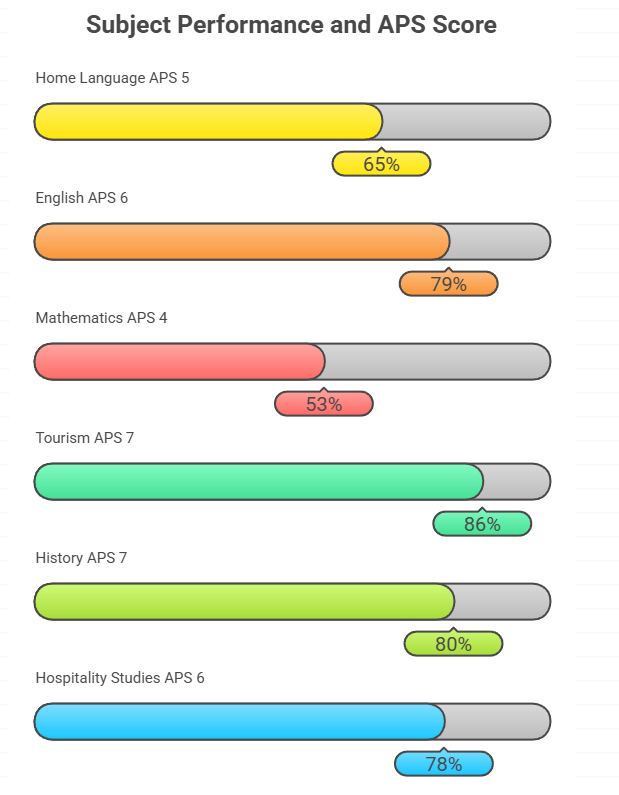
Based on the matric final percentage and its complementing APS level, they will score 35 on the APS Scale. This is well above the required APS score of 26 for admission into the programme.
However, if they had scored a total of 34 but with a score of 5 in English, they would not have been eligible for the programme because they did not meet the APS score requirement for English.

Programmes you are Eligible for After Calculating Matric Marks
Students in South Africa apply for undergraduate programmes based on their Grade 11 or mid-year matric results. Universities typically offer a conditional acceptance, with final letters sent after the release of the matric scores.
Listed below are Regenesys undergraduate programmes that prospective students can still apply for:
- Bachelor of Business Administration (BBA)
- BCom in Banking and Financial Services
- Bachelor of Accounting Science (BCOMPT)
- Higher Certificate in Business Management (HCBM)
- Higher Certificate in Public Management (HCPM)
- Bachelor of Public Management (BPM)
- Bachelor of Science in Computer Science
- Bachelor of Education in Senior Phase and Further Education and Training Teaching
- Bachelor of Laws (LLB)
- Family Law Practitioner
- Paralegal Qualification
What is the Importance of Understanding the Matric Marks Calculation?
The matric scores that students receive on their Grade 12 or matric exams help to determine higher education pathways for South African students. Therefore, it is important for students to understand the required and elective subjects, the weightage they carry, and whether they will help secure university admission.
These are some reasons why it is important to understand the matric marks calculation:
- Helps students track their performance and understand how it contributes to the overall score.
- Makes it easier for students to determine academic and professional pathways available after Grade 12.
- Supports informed decision-making when selecting matric exam subjects.
- Allows students to identify subjects that will require improvement in the final exams.
- Makes it possible for students to develop clarity regarding admission requirements.

Admission Process Guidance After Matric Result
In case you have still not applied for an undergraduate programme, it is possible to apply for the February intake at Regenesys Education. At Regenesys, programmes are available for students who have secured a Higher Certificate or a Bachelor’s pass in the matric exams.
Follow the steps listed below to apply to one of our accredited programmes:
- Visit the Regenesys Education website.
- Navigate to ‘Study at Regenesys’ and click on a programme of your choice.
- Check programme requirements.
- Complete the application process.
- Submit the application fee.
- Finish the documentation process.
- Pay fees and start enrolment.
Financial Support for Your Academic Pathway
At Regenesys, we believe that financial obstacles should not hinder your educational progress. To help you manage the costs, we collaborate with Student Hero, Fundi, and offer the flexible FlexiPay option. These solutions are designed to make financing your studies easier, so you can focus on what truly matters—your education and future success.

Explore Our Other Programmes
Conclusion
The best way to succeed and score well during the matric exams is to be prepared. Preparation is more than just studying for the subjects, and begins months in advance when students decide on their future field or course of study.
It is important for students to understand programme specific requirements, as it helps them select matric subjects that will guide them to gain admission. The final matric marks help to determine higher education and vocational pathways that are available to South African students.
If you are still waiting to secure a seat for next year, we are still accepting applications. Visit Regenesys Education and explore the various higher certificate and undergraduate programmes.
FAQs
Is the matric score same as the APS level?
The matric score is the percentage students earn for each subject that they appear for during the NSC or matric exam. However, universities convert each subject score to an APS level. Therefore, the APS is derived from the matric score.
What is the difference between the NQF and the APS level?
The NQF level is awarded after students complete a certain level of education. An APS level is determined from the matric score and is a criterion for admission.
What are the compulsory matric subjects?
There are 4 compulsory matric subjects: a home language, another language, mathematics or mathematics literacy, and life orientation.
Why can’t matric scores be used directly for admission?
Matric scores are percentages scored out of 100, while the APS score assigns a level to that score. The maximum APS score a student can achieve is 42.
How to calculate matric points?
Check the final grades for all the subjects, excluding life orientation. Convert the grades to APS points. Next, you add the points, and that is your final score.