

Every 24 January, the world puts education on a pedestal. South Africa puts it on a scoreboard. We celebrate pass rates. We trend hashtags. We applaud “record results”. And then we quietly watch thousands of capable young people hit a locked gate labelled “No Space”. That contradiction is the real story of International Day of Education.
UNESCO frames the 2026 International Day of Education around “the power of youth in co-creating education”, a call to stop treating young people as passive recipients and start building systems with them, for their futures. In South Africa, that call lands in a country where the pipeline keeps producing ambition faster than the system can absorb it.
Education must be reachable, not just admirable. Because the most dangerous sentence in South Africa right now is not “I failed”. It’s “I passed, and there’s still nowhere to go.”
Bachelor’s passes trend (2015–2025)
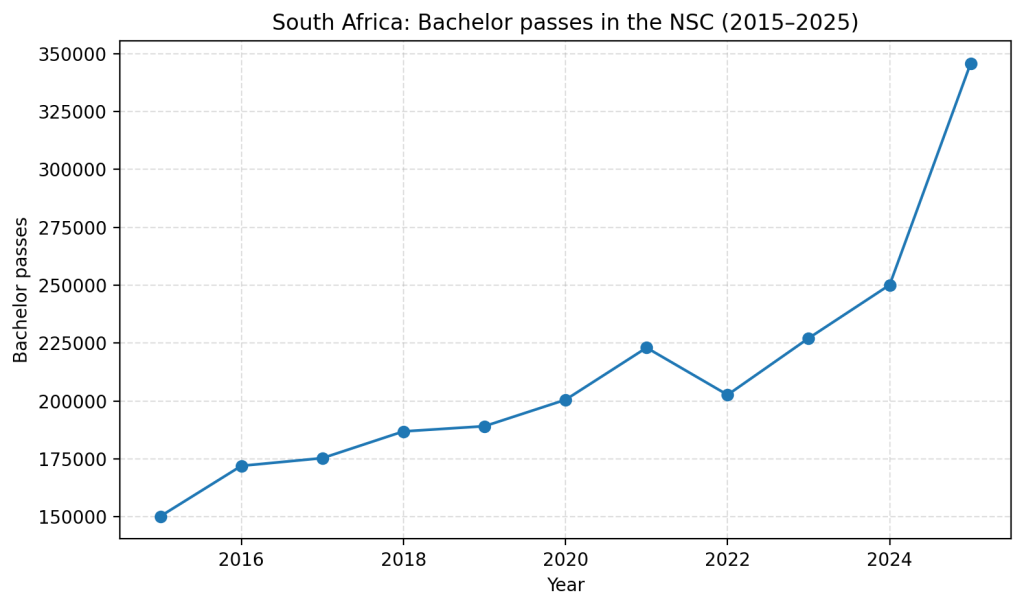
NSC Bachelor’s passes from DBE reporting.
The Numbers That Should Make Us Uncomfortable
The Department of Basic Education’s 2025 National Senior Certificate report shows:
- 746,110 learners wrote the NSC.
- 656,221 achieved the NSC.
345,857 achieved a Bachelor’s pass. 2025 NSC outcomes (counts)
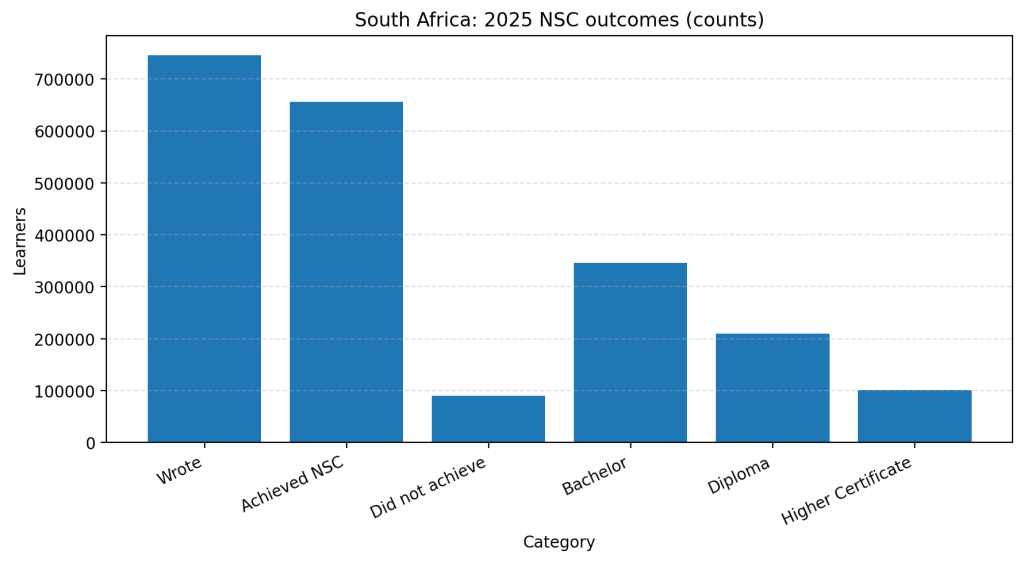
Wrote, achieved NSC, and passed categories from DBE’s 2025 NSC report.
Those are not just statistics. That is a country manufacturing hope at industrial scale. Now put that next to the capacity reality. In January 2026 briefings on readiness for the new academic year, South Africa’s public university system is described as having about 235,000 first-year places for the 2026 intake.
Even if we use the most conservative comparison, it exposes a brutal arithmetic:
- Bachelor’s passes (345,857) versus public university first-year places (235,000) equals a gap of 110,857 young people.
A gap that does not show up in the celebrations. A gap that becomes a silent epidemic: deferred dreams, wasted momentum, and a growing pool of youth forced into a holding pattern that society often mislabels as “laziness”.
The capacity gap: NSC outputs vs first-year public university spaces
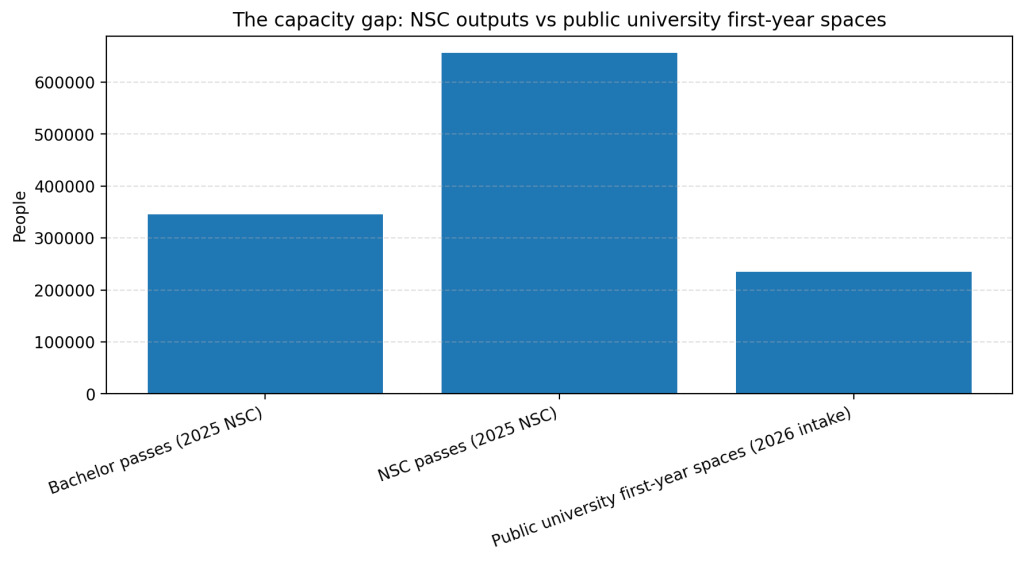
DBE NSC outcomes vs reported public university first-year capacity.
Stats SA’s labour data puts a hard edge on that reality: in Q1 2025, 45.1% of 15–34-year-olds were not in employment, education, or training (NEET). For ages 15–24, it was 37.1%. When “no space” becomes your answer, the risk is not only economic. It is psychological. It is social. It is national.
The Pressure Is Visible At The Front Door Of Every Top Institution
This is measurable in queues, waitlists, and inboxes. Wits, for example, communicates that it receives around 116,000 applications for approximately 6,000 first-year places. The University of Johannesburg reported roughly 395,000 individual applicants submitting about 828,000 study choices, with a first-year intake target of 10,571. UKZN has also described demand at a scale that far outstrips capacity, with application volumes in the hundreds of thousands for a far smaller intake.
Yes, application counts can be inflated because one learner applies to multiple institutions and programmes. The core truth does not change: demand is overwhelming, and capacity is finite.
So the question International Day of Education should force us to ask is not “How many passed?” It is: “How many progressed?”
Post-school enrolment by institution type
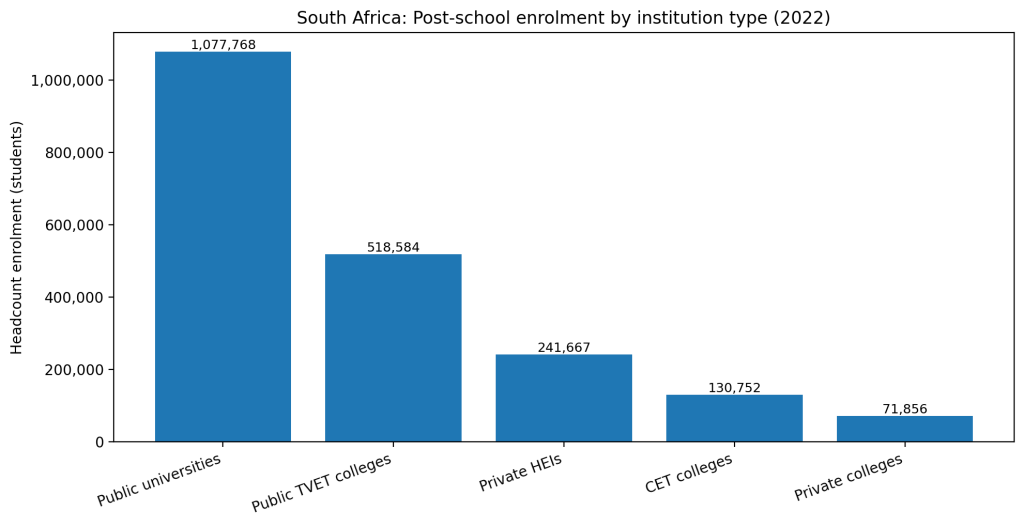
Source: Council on Higher Education (CHE) VitalStats 2022; Bawa & Meyer (2025) citing CHE (2024) and Wills et al. (2024)
South Africa’s Real Education Crisis Is Not “Matric Failure”. It’s Post-Matric Abandonment.
A system that produces passes without producing places is not solving education.
It is manufacturing disappointment. And the “no space” problem is bigger than universities.
South Africa’s post-school education and training (PSET) system is meant to include multiple routes: universities, TVET colleges, CET colleges, and skills programmes. The PSET Monitor shows millions already enrolled across these pathways, with large numbers in public universities and TVET, plus significant participation in CET and other routes. So why does the pressure still feel like a chokehold?
Because capacity is not the only constraint. Confidence is.
- Many learners are never properly guided into alternative pathways that match their strengths.
- TVET is still treated like a “backup plan” in too many households.
- The system does not move fast enough to absorb new demand at the scale the country is generating it.
- Young people lose time, and time becomes discouragement.
International Day of Education is supposed to be about human potential. South Africa’s gap turns potential into paperwork, and paperwork into waiting.
The Five-Step Route That Actually Closes The “No Space” Gap
South Africa doesn’t need another round of hand-wringing. The blueprint is already visible, if we’re brave enough to follow it. Fixing the “no space” crisis means building a post-school system that behaves like a real pipeline, not a lottery: transparent, coordinated, and designed to keep young people moving forward. Here are five moves that, together, shift the country from scarcity thinking to scale thinking.
1) Build A National “Capacity Map” In Real Time, Not After The Damage Is Done
No family should be forced to guess where opportunities exist. A live, national capacity map across the entire post-school ecosystem must become standard, updated weekly in peak season: what’s open, what’s full, what entry requirements apply, and what pathways still have room.
South Africa is already moving toward centralised support through channels like the Central Applications Service (CAS). The next leap is simple: make the information visible at the speed students need it, not only available through a helpdesk.
2) Treat Accredited Private Institutions As Capacity Partners, Not Side Characters
A country with a capacity crunch cannot afford to sideline legitimate, accredited private providers. Yes, families must be protected from bogus institutions, and verification must remain non-negotiable. But safeguarding the public should not come at the cost of underusing real capacity.
The smartest route is a transparent partnership model: accredited private institutions expand seats in priority fields, quality standards are enforced, outcomes are reported publicly, and the system gains thousands of additional places without waiting years for new campuses.
3) Make Articulation Pathways The Default, Not The Exception
The biggest lie we tell young people is that there is only one “correct” entry point. Progress is not a single doorway. It is a designed route. Higher Certificates, bridging options, online-first starts, and step-up programmes should be built as mainstream pathways that lead to diplomas and degrees with dignity, not stigma.
When articulation works, “not enough points” stops being a dead end and becomes a detour with momentum.
4) Expand High-Impact Hybrid Delivery Where It Genuinely Increases Seats
Hybrid learning should not be framed as convenience. Its real power is scale. Done properly, hybrid models unlock capacity by sharing high-demand modules, strengthening academic support, and using timetables and delivery formats that stretch physical infrastructure further without lowering standards.
This is how you grow access quickly while protecting quality, and it is how you turn limited lecture halls into broader reach.
5) Rebrand Skills Routes With Outcomes, Not Slogans
TVET and occupational pathways will only win trust when outcomes are undeniable and visible. Families don’t reject skills routes because they hate skills, they reject uncertainty. Publish placement rates, employer partnerships, internship pipelines, and clear earning and progression pathways.
When results are public, stigma collapses. When the route is clear, confidence returns.
Because the truth is simple: hope becomes real when the next step is visible.

A Practical Guide For Students Still Looking For Space Right Now
If you are still searching in late January, you are not “too late”. You are in a system that moves slowly and communicates poorly. Here is how to move with precision.
Step 1: Use Official Placement Support Channels
The DHET’s Central Applications Service (CAS) has been communicated as a support channel to help applicants navigate opportunities and placement options, including direct contact support via WhatsApp in public communications.
Step 2: Work The System Weekly, Not Once
Admissions shift as people accept, decline, or miss deadlines. That means spaces open up in waves. Check portals and communication channels consistently.
Step 3: Broaden Your Target Intelligently
Do not apply “anywhere”. Apply where you can actually succeed.
- If you are strong in people, commerce, or management: look at business, leadership, and administration pathways.
- If you are practical and technical: prioritise TVET routes that lead to employability and entrepreneurship.
- If your marks are borderline for your dream programme: consider a bridging route that keeps you progressing rather than pausing.
Step 4: Verify Every Institution Before You Pay Anything
If you consider a private provider, verify registration and programme accreditation. Public briefings repeatedly warn families about bogus providers masquerading as legitimate institutions.
Step 5: Prepare Your Funding Plan Early, Even If You Think You “Won’t Qualify”
Funding is not one door. It is many doors. And the worst mistake is waiting until you have an offer before you explore options.

Where Regenesys Fits: As A Statement Of Principle
International Day of Education is not about praising education in theory. It is about protecting education in practice. And the most practical thing a country can do, when thousands of young people are ready to learn, is ensure there is a credible place for them to keep going.
That is where Regenesys Education stands. Not on the sidelines of South Africa’s education story, but inside the problem itself, facing it head-on with a simple belief: access is not charity, it’s justice. Education should not depend on whether a campus has an empty seat when you happen to apply. It should depend on whether you are willing to do the work.
Regenesys lives and breathes the core promise behind International Day of Education; that education is a public good with private impact. It is the difference between a life on pause and a life in motion. It is how societies break cycles, not just for individuals, but for entire families. When the system tells a determined student “wait”, Regenesys refuses to let that waiting become a life sentence.
Here is the hard truth most institutions won’t say out loud: when demand outstrips capacity, it is not only access that collapses, it is momentum. And momentum is everything at that age. The longer a young person sits at home after matric, the more confidence erodes, the more doubt creeps in, the more “later” becomes “never”. Regenesys is designed to protect momentum, because momentum is what turns potential into outcomes.
This is why Regenesys positions itself as an institution of continuation: a place that treats capability seriously, and treats time as precious. If you are ready to build a future, you should not have to beg the system for permission to start.
Explore Regensys Programmes still Available
Student Funding Solutions
Because access without affordability is just a softer form of exclusion, Regenesys backs its access mission with funding pathways that make continuation realistic. FlexiPay exists for the student who has the ability, the discipline, and the ambition, but cannot carry the full financial weight upfront. The message is clear; financial constraints should shape the plan, not erase the dream.

Regenesys’ broader access ecosystem, including partnerships and support initiatives that widen entry into post-school education, reflects the same stance: progress should not be reserved for the lucky few who find a seat early, have perfect timing, or have perfect resources. Progress belongs to the persistent.
International Day of Education asks what we are doing to make education real, not rhetorical. Regenesys answers by doing the one thing that changes everything for a young person: opening a door that leads somewhere.
International Day of Education: What We Should Stop Saying, And What We Should Start Building
We should stop saying “at least you passed” as if passing is the finish line. Passing is the receipt. Progress is the product.
International Day of Education is not a moment for inspirational quotes. It is a mirror. It asks: when young people do their part, does the country do its part? If the answer is “not yet”, then the response cannot be sympathy. It has to be infrastructure, pathways, funding models, and capacity partnerships that scale.
And it has to happen loudly, because silence is how crises become normal.
An Invitation To Keep Going: Regensys Open Days
Regenesys’ Open Day on Saturday, 24 January 2026 is timed to International Day of Education for a reason; access has to be practical, not poetic.
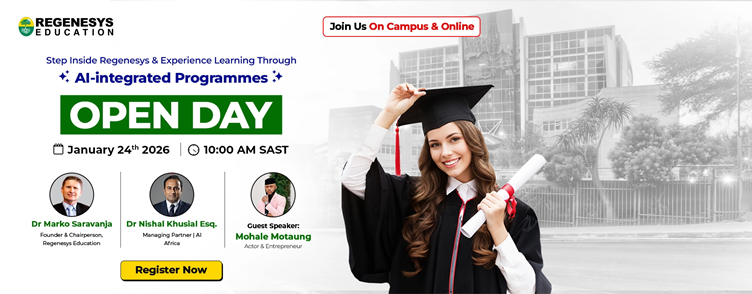
Open Days will run every Saturday until the end of February on Campus at 165 West Street Sandton and Online:
- 24 Jan 2026
- 31 Jan 2026
- 7 Feb 2026
- 14 Feb 2026
- 21 Feb 2026
- 28 Feb 2026
If you are a student still looking for a place, come with your questions, your documents, and your ambition. If you are a parent watching your child lose momentum, come with your urgency. And if you are a policymaker, employer, or funder, come with your willingness to build capacity, not commentary.
Explore what Regenesys has to offer, and use these Open Days as a decision point: not “Can I get in?”, but “How do I keep moving?” Because in a country like ours, momentum is not a luxury. It is necessary.