
Accounting is a field that requires a strong foundation in mathematics. Accountants work with numbers every day to record, analyse, and interpret financial data.
They use maths to prepare reports, calculate profits, manage budgets, and check financial accuracy. These skills help businesses make sound financial decisions. A clear understanding of mathematical concepts allows accountants to perform their duties confidently and efficiently.
If you’re considering a career in accounting, you may ask this: “What math do you need for accounting?” You may also wonder what specific maths skills are needed to excel in this domain. In this article, let’s explore the critical mathematical concepts considered important for accountants.
Table of Contents
What Is Accounting?
Accounting is an essential part of every business or organisation. It records, analyses, and interprets financial transactions to show a company’s financial health. Accountants use this information to ensure accuracy and reliability in financial reporting.
Accounting plays a key role in decision-making, financial planning, and measuring business performance. It applies to all types of businesses, from small companies to large corporations.
Often called the language of business, accounting helps track income, expenses, assets, liabilities, and equity. Accountants prepare financial statements such as balance sheets, income statements, and cash flow statements. These reports show how a business is performing and help stakeholders make informed decisions.
Read More: Where Can You Study Accounting in South Africa? A Complete Guide
Does Accounting Require Math?
Yes, accounting requires maths, and the maths for finance careers is simple and practical. Accountants use numbers every day to record and check financial information. They apply basic arithmetic such as addition, subtraction, multiplication, and division to manage transactions accurately.
Maths helps accountants create budgets, calculate profits and losses, and analyse financial statements. They also use percentages, ratios, and averages to measure business performance. In some cases, they use formulas to calculate interest, depreciation, or tax amounts.
Accounting depends more on understanding financial patterns than solving complex equations. With good basic maths skills and attention to detail, anyone can build a successful career in accounting.

What Math Do You Need for Accounting?
Math is an important part of accounting. Accountants work with numbers, calculations, and financial data every day. To perform this in the right way, you need a good grasp of basic maths concepts. These skills support accuracy, consistency, and sound financial judgement. They also form the foundation for further study in accounting and finance.
Here are the maths requirements for accounting:
1. Basic Arithmetic: Accountants use addition, subtraction, multiplication, and division to record and check financial transactions. These basic skills help them work accurately.
2. Fractions and Percentages: When calculating interests, margins, as well as breaking down funding distributions, accountants can effortlessly transition between fractions, decimals, & percent signs to decipher financials.
3. Algebra: Algebra helps accountants solve equations and find unknown values. They use it to calculate depreciation, interest, and taxes. A good understanding of algebraic expressions and variables guarantees accurate decision-making.
4. Statistics: Accountants use statistics to determine the trends that exist within the data by examining the means, variability, and other patterns.
5. Probability: Probability helps accountants assess the likelihood of certain outcomes. It is useful in auditing, forecasting, and risk management. Knowing how to estimate chances supports better financial planning.
6. Calculus: Some accountants use calculus to study changes in revenue or costs over time. It helps when analysing growth rates or predicting profit changes. Although not needed for all roles, basic knowledge of calculus can be useful.
7. Financial Mathematics: This includes compound interest, present value, and future value calculations. These concepts help accountants measure investment returns, plan budgets, and forecast cash flows.
All these things efficiently answer the question: “What math do you need for accounting?” Strong maths skills make accounting work accurate, logical, and reliable. With these foundations, accountants can manage financial data and support sound business decisions.
Read More: Understanding the Different Types of Accounting Science Degrees in South Africa
Subjects You Need for Accounting
Choosing the right high school subjects lays a strong foundation for an accounting career. These subjects develop analytical, numerical, and business skills needed for further studies in accounting. They also prepare learners for university entry and help them understand key maths and financial concepts.
Here are the recommended subjects needed for accounting:
- Accounting: Introduces learners to financial records, budgeting, and basic reporting. It builds an early understanding of how businesses track income, expenses, and financial performance.
- Mathematics or Mathematical Literacy: It is preferred for BCom Accounting. Mathematics develops numerical accuracy, problem-solving, and analytical thinking, which are essential for accounting studies.
- Economics: Helps learners understand how markets, businesses, and financial systems operate. It provides useful context for interpreting financial data and understanding economic trends that affect organisations.
- Business Studies: Explains how businesses are managed, structured, and financed. It supports accounting studies by linking financial information to real business decisions.
- English: Important for reading financial reports, writing clear explanations, and communicating with clients or stakeholders.
- Information Technology or Physical Sciences (Optional): Builds digital skills useful for accounting software and data management. Physical Sciences builds logical reasoning and analytical skills.
Know more: The Role of Accounting in Business: Understanding the BCOMPT Degree
Path to an Accounting Career
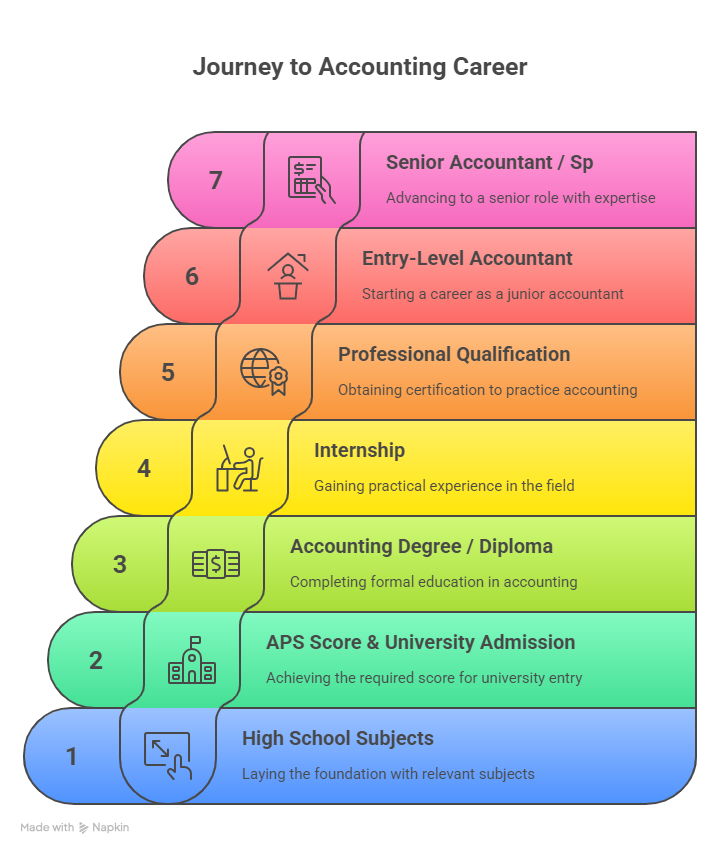
Building a career in accounting involves several academic and professional stages. Each stage helps learners gain knowledge, experience, and analytical skills to succeed in the financial field. Knowing this pathway helps aspiring accountants plan their studies and career goals effectively.
Learners interested in finance-focused roles can begin with a Bachelor of Business Administration (BBA) in Finance. It provides a strong foundation in accounting, financial analysis, and business principles.
After gaining enough experience, postgraduate options such as an MBA – Master of Business Administration in Finance support career growth into senior finance or management roles.
Here is a visual path showing the typical journey to becoming a qualified accountant:Read More: Career Opportunities With A Bachelor of Accounting Science Degree
Explore Career Opportunities With A Bachelor of Accounting Science Degree
Explore Our Other Programmes
Conclusion
A strong foundation in mathematics is important for success in accounting. From basic arithmetic to concepts like algebra and statistics, accountants must work confidently with numbers and financial data. Good maths skills help them understand transactions, prepare accurate reports, and make sound business decisions.
At Regenesys Education, we offer accounting and finance programmes that help you build these essential skills. You can enrol in these programmes to strengthen your mathematical understanding and prepare for a successful career in accounting.Dreaming of a career in finance? Start with a Bachelor of Business Administration (BBA) in Finance at Regenesys Education.
FAQs
What subjects are needed for accounting?
Subjects such as Accounting, Mathematics, and English are needed. Business Studies and Economics are also useful.
What are the accounting prerequisites?
You need a National Senior Certificate (NSC) with good marks in Mathematics and English. Some universities prefer Accounting or Business Studies.
What maths do you need for accounting?
You need basic arithmetic, algebra, and statistics to handle calculations and analyse financial data.
How important is maths for finance careers?
Maths is essential. It helps you manage budgets, analyse trends, and make sound financial decisions.
Do I need advanced mathematics for an accounting career?
No, you don’t. Most accounting jobs only need basic maths and logical thinking.