Why Study a Bachelor of Laws (LLB) in Polokwane?
Studying an LLB in Polokwane allows students to combine academic learning with real social and institutional exposure. As Limpopo’s administrative centre, the city presents practical legal issues linked to governance, business, and community development. This environment helps students understand how law functions beyond theory. As a result, graduates develop skills that are directly aligned with regional and national needs.
High employability and professional opportunities
An LLB equips graduates with skills that remain relevant across multiple industries. Legal reasoning, research, and compliance knowledge are valued well beyond law firms. This broad applicability improves long-term employability. Graduates, therefore, remain competitive in both traditional and emerging roles.
Rising need for legal compliance, corporate law, and litigation specialists
As regulations increase, organisations require professionals who can accurately interpret and apply the law. Corporate compliance and governance have become essential for sustainable operations. At the same time, dispute resolution remains a critical legal function. These combined needs continue to strengthen demand for law graduates.
Pathway to becoming a lawyer, advocate, or legal consultant
The LLB is the recognised academic foundation for legal practice in South Africa. It leads directly into professional legal training pathways. Through this progression, graduates can pursue careers in advocacy, consultancy, or the judiciary. Each role builds on the same structured legal education.
Competitive advantage in business, governance, and policymaking
Legal training develops structured thinking and informed decision-making. This is particularly valuable in leadership and policy roles. Law graduates understand regulatory impact and risk. Consequently, they contribute more effectively to governance and strategic planning.
LLB in Polokwane Requirements: Eligibility, Qualifications & Admission Criteria
The LLB admission process in Polokwane is designed to assess a student’s academic readiness and interest in legal studies. Institutions aim to select candidates who are prepared for undergraduate-level legal education and can actively engage in lectures, case discussions, and practical legal learning. It is important to confirm the exact admission process through the official sources of your chosen institution.
The process at Regenesys typically includes the following steps:
Step 1: Review the LLB programme eligibility requirements.
Step 2: Complete and submit the application form.
Step 3: Pay the application fee.
Step 4: Submit all required supporting documents.
Step 5: Pay the programme fees and confirm enrolment.
You can follow these tips to ensure a smooth admission process:
- Check the eligibility criteria carefully before applying.
- Prepare and organise all required documents in advance.
- Pay the application fee promptly, as applications are generally processed only after payment is received.
LLB Programme Structure & Core Modules
The LLB programme is designed to help students understand the law step by step. Learning begins with basic legal ideas and skills, then moves into the advanced subjects and practical application. Each year builds legal thinking, ethical awareness, and confidence needed for professional practice.
Foundation Stage: Building Legal Awareness (Year 1)
In the first year, students learn how the legal system works and develop essential study skills. Pillars of South African Law introduce the structure and sources of law. The Law of Personas and Family Law focus on legal identity, relationships, and personal rights.
To support learning, students study Legal English and Computer Literacy, including legal research skills. Modules such as Foundational Personal Mastery and Emotional and Spiritual Intelligence help students build self-discipline, communication skills, and professional behaviour.
Core Legal Principles and Interpretation (Year 2)
In the second year, students usually focus on key legal subjects that form the base of legal practice. Constitutional Law and the Bill of Rights explain how the Constitution protects rights and limits state power. Jurisprudence helps students understand legal thinking and reasoning.
Contractual matters are covered through the Law of Contract, Specific Contracts, and Law of Succession. Legal Interpretation, Legal Pluralism, and Roman Law improve analytical skills and expose students to different legal traditions. Patent and Copyright Law introduces intellectual property protection.
Application and Business-Focused Law (Year 3)
In the third year, students apply legal principles to practical situations. The Law of Business Entities explains how businesses are formed and managed. International Law and Intellectual Property Law introduce global and innovation-related legal issues.
The Law of Delicts and the Law of Evidence focus on civil liability and legal proof. Administrative Law, Law of Property, and Introduction to Law Tax explain government powers, ownership rights, and basic taxation. Research Methodology builds legal research and writing skills.
Professional Practice and Procedure (Year 4)
The final year prepares students for legal practice. Criminal Law explains criminal responsibility and justice. The Law of Civil Procedures and the Law of Criminal Procedures teach court processes and case handling.
Labour Law covers employment rights and workplace issues. Legal Ethics and Practices focuses on professional conduct, responsibility, and ethical decision-making. These subjects help students transition from academic study to professional training.
Electives: Exploring Specialised Legal Areas
Electives allow students to explore areas that match their interests. Early electives such as Business Management, Economics, and Financial Accounting build business understanding.
Final-year electives, including Cyber Law, Environmental Law, Medical Law, Insurance Law, International Business Law, and Accounting for Legal Practices,focus on specialised and emerging legal fields. These subjects help students prepare for a diverse range of legal careers.
Top Law Schools Offering LLB in Polokwane
Polokwane is home to several reputable institutions offering accredited LLB programmes that prepare students for careers in law, legal practice, and public administration. Choosing the right law school is essential to ensure academic quality, professional recognition, and career readiness.
Some of the leading law schools in Polokwane include:
- Regenesys Law School
- University of Limpopo
- Rosebank College – Polokwane Campus
These institutions ensure that students receive a solid legal education while gaining the skills and experience necessary to succeed in the legal profession.
Cost of Studying Law in Polokwane
The cost of studying law in Polokwane depends on the institution and mode of study. Tuition fees are only part of the total expense, so careful financial planning is essential to stay focused on learning. Private institutions typically charge higher fees, while public universities often provide subsidised rates. Online programmes can help reduce some costs, and fees are usually reviewed annually.
Students should also budget for textbooks, study materials, library access, faculty fees, accommodation, and transport. Casebooks and other essential resources may add to the overall cost. Early planning helps manage expenses effectively, while shared accommodation and digital resources can lower spending. Many institutions offer financial assistance, including student loans, flexible payment plans, and other external funding options, though eligibility criteria apply.
Career Opportunities After an LLB in Polokwane
An LLB provides access to a diverse range of career paths. Graduates are not limited to courtroom practice. Legal skills transfer across industries. This flexibility strengthens career resilience.
Traditional legal careers
Graduates may pursue careers as attorneys or advocates, while judicial and legal research roles also offer viable pathways. Entry into these professions requires formal admission and adherence to professional standards. Each role builds directly on core legal training, applying legal knowledge to practice, analysis, and decision-making.
Corporate and non-traditional roles
Law graduates find opportunities across compliance and advisory roles, where corporate environments place strong value on legal expertise. Alongside traditional pathways, arbitration and mediation have emerged as effective alternatives for dispute resolution. As regulations expand and businesses seek risk-aware guidance, demand for legally trained professionals continues to rise.
Public service and NGO careers
Government institutions consistently require legal professionals to support regulatory, administrative, and policy functions. NGOs value law graduates for their strong research, advocacy, and analytical skills, while policy-oriented roles align well with their legal training. Together, these career paths enable law graduates to contribute meaningfully to social impact and public good.
How to Become a Lawyer in Polokwane After Your LLB?
The LLB is the foundational step toward a career in legal practice. After completing the degree, graduates must fulfil additional professional requirements that vary depending on the sector and legal pathway they choose. These steps ensure that legal professionals are properly trained, assessed, and authorised to practise.
Law school and training requirements
Graduates are required to complete recognised legal training programmes that focus on developing practical and professional skills. These programmes help bridge the gap between academic learning and real-world legal practice. Approved institutions guide candidates through this process, and specific admission criteria must be met.
Bar examinations and assessments
Professional examinations are conducted to assess a graduate’s readiness to practise law. These assessments ensure that candidates meet the required standards of competence, ethics, and legal understanding. Thorough preparation is essential, as successful completion is mandatory for progression.
Call to the Bar and registration
Once examinations are cleared, graduates participate in formal admission ceremonies, often referred to as the call to the Bar. Registration with the relevant legal authority grants the right to practise law. From this stage onward, adherence to ethical and professional standards is compulsory.
Mandatory service and licensing
Some jurisdictions require a period of mandatory service before full licensing is granted. Licensing formally confirms professional status, while continuous professional development is encouraged to maintain competence. Ongoing regulation helps protect public trust in the legal system.
Why Choose Regenesys for LLB in Polokwane?
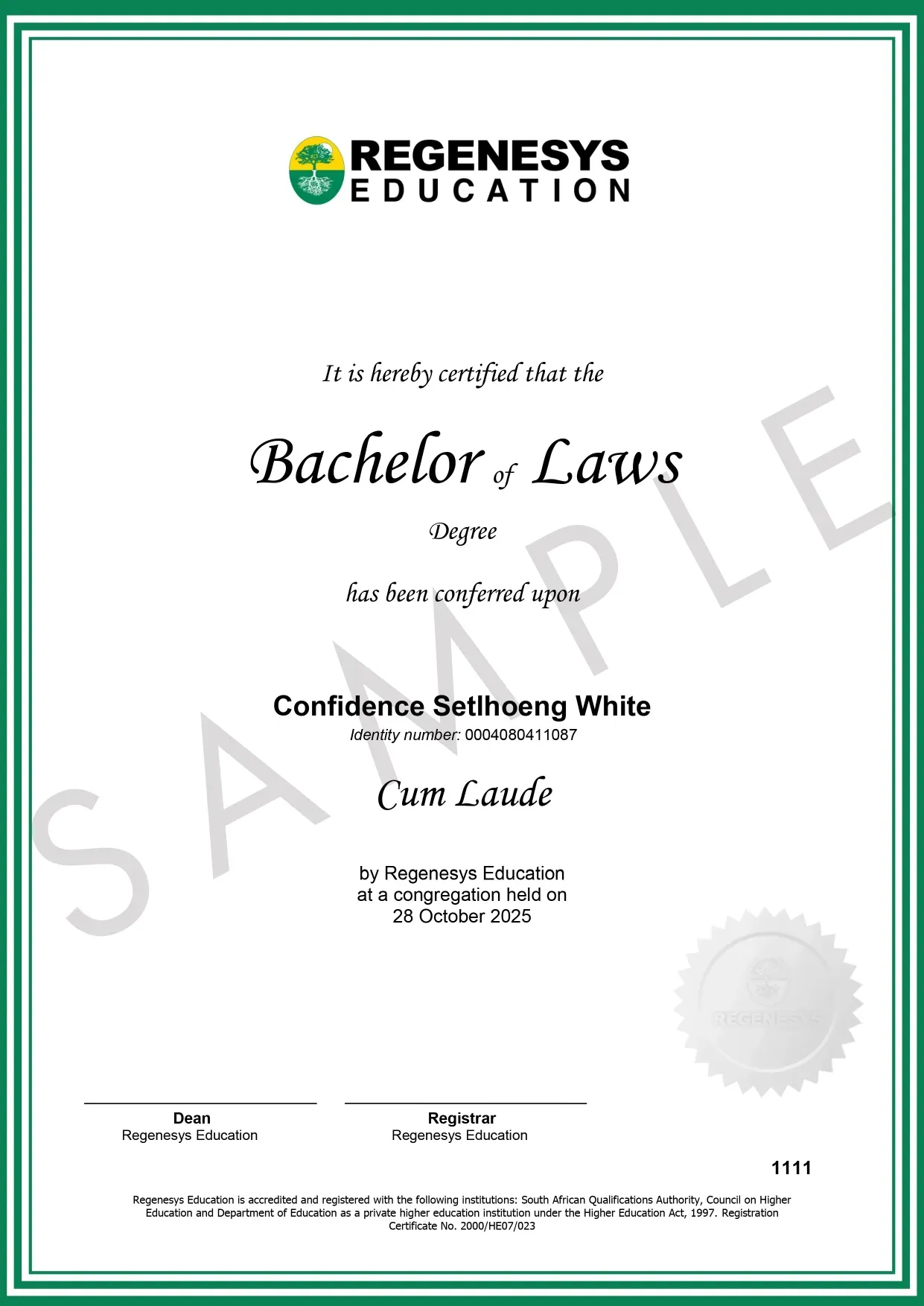
Regenesys is an excellent choice for pursuing an LLB in Polokwane, offering a blend of academic credibility, practical legal training, and career-focused support. The programme equips students with the knowledge, skills, and experience required to succeed in legal practice, while providing global exposure and flexible study options.
Key Reasons to Choose Regenesys:
- Strong Academic Reputation: Over 25 years of educational excellence and a network of 500,000+ alumni worldwide.
- Global Exposure: Students from 180+ countries and a diverse faculty of 100+ experts enhance the learning experience.
- Structured Curriculum: Focused on legal principles, practical application, and professional competencies for law careers.
- Flexible Study Options: Learn through contact, online, or blended modes to balance studies with personal or professional commitments.
- Robust Support Systems: Comprehensive academic guidance, mentorship, and career support improve student success and employability.
- Accredited Programmes: SAQA-registered degrees ensure recognised qualifications for legal practice and long-term career value.
- Financial Assistance Opportunities: Student loans and flexible payment plans make legal education accessible.
Choosing Regenesys allows students in Polokwane to gain a meaningful legal education, practical skills, and global perspectives, preparing them for impactful careers in law.